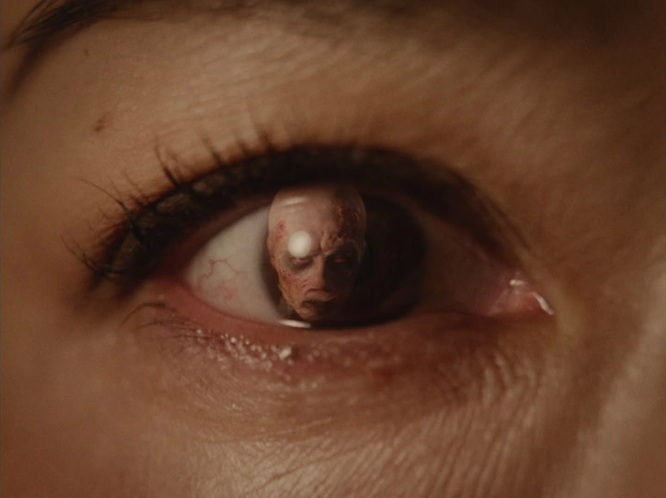
Bi Gan’s latest and beloved film Resurrection (2025) is set in a future where humans have given up dreaming in exchange for immortality; but an artist, The Big Other (Shu Qi), finds the fading dreams in the perishing monster Deliriant (Jackson Lee). These dreams, presented by the film in distinct chapters that features the Deliriant in changing appearances, unravel a century-long cinematic history, from silent cinema and fantastical neo-noir (with which Bi Gan has already experimented in Long Day’s Journey into Night [2018]) to the end of cinema, making the Deliriant the personified figure of cinema itself.
In Resurrection’s opening sequence, The Big Other opens up the back of the Deliriant, revealing it to be a projector which launches his cinematic dreams. Through the violence that follows, that envelops and acts upon the Deliriant—from cutting open his body to knocking out his teeth, to the abundance of blood as a seemingly perpetual happenstance around him—Resurrection almost visualizes Victor Fan’s description of cinema: an “anthropotechnical consciousness” that “always operates on and within violence.” [1] Under this premise that cinema is a human-technological entity, the film presents cinematic history as the lingering dream of the (dis)embodied cinematic person, but effectively ignores the technological half of its own conceptualization. In the film, the development of cinematic technology matches the senses of the Deliriant himself, the latter being organized into six allusive chapters that parallel the six senses of Buddhism [2]. However, the film’s ambiguous, almost avoidant attitude toward actualizing and contextualizing the historical development of cinematic technology makes the reception of the film seem a bit too generous.
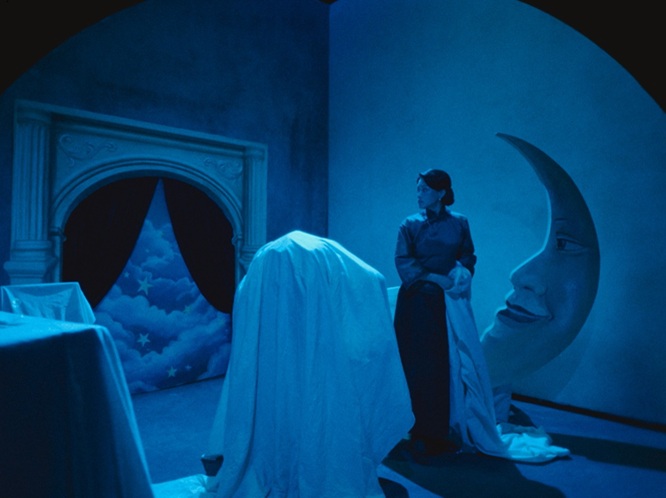
For example, Resurrection’s inception point—when The Big Other encounters the Deliriant—simultaneously and nostalgically resembles Expressionism, Republican China and a Lynchian floating parallel, rather than a supposed future, whereas the subsequent dreamscapes take their shapes and forms from twentieth-century China. As a result, this cinephilic film demandsthat the audience decode its technical take on film history to follow its theme (the love of and/or mourning for cinema), but it paradoxically both centers and bypasses this very technicality. That is, the metacinematic discourse of Resurrection imposes a certain responsibility—in the form of knowledge, perhaps—as a requirement to engage with its seriousness, yet neglects its own responsibilities in turn.
Nevertheless, if we do follow Resurrection’s logic and engage with the historical view of this technological condition as the foundation of cinema, we would find that cinema as a medium was not so much invented with a clear purpose, but rather, like other tools and technologies, as an extension of the human body; in this respect, cinematic technology is akin to writing, as it expresses bodily gestures more than it pictorially transcribes visual experiences [3]. So, the birth of cinema was more of a pragmatic coincidence than a well-planned act of heroism; it reflects the assemblage and experimentations of available technological means at the time. Cinema’s purpose, then, is a question that comes after the image: the giving in to, instead of the recruitment of images. The images as subjectivity itself. In disengaging from reality and the world, Resurrection unfortunately lacks a coherent subjectivity and only fills this void with various cinematic references.
Resurrection’s Deliriant dreams of a hundred years of solitude; his dreams, more than showing his surroundings, are a feast of impenetrable spectacles of himself, rendering all participants in his dreams as dead ghosts. The form of Bi Gan’s cinema is especially incompatible with his subject matter here, as we almost never see what cinema (the Deliriant himself) sees: the Deliriant’s human form is always in frame and in focus, at the centre of the film’s self-absorbed interest and gaze. When it isn’t, the camera floats in extravagant long takes—a demonstration of an external artistic will that effectively lifts the film out from its diegesis by the all-powerful auteur’s hands (the long takes’ purpose is never fluidity, the form is attention-seeking in its essence). Moreover, this artistic intention is not consistently displayed: it is sometimes figuratively disguised in the self-representing artist character, The Big Other, and at other times, it quite literally appears as a pair of big hands or as the camera in front of her skylight. So, entering the Deliriant’s dream establishes a visual contract that tethers our eyes to him as an object rather than to his eyes, which would have rendered him a subject. The missing perspective, and therefore subjectivity, makes cinema/the Deliriant chillingly passive; his wounds are never painful, and neither is the sorrow he causes in others. To this effect, he is viewed as a celebrity (not even as an actor, like the character in Leos Carax’s Holy Motors [2012]), as if he were performing in a Super Bowl halftime show, maneuvering in and out of ostentatious long takes and being enveloped not by fantastical reality, but by realistic fantasy.
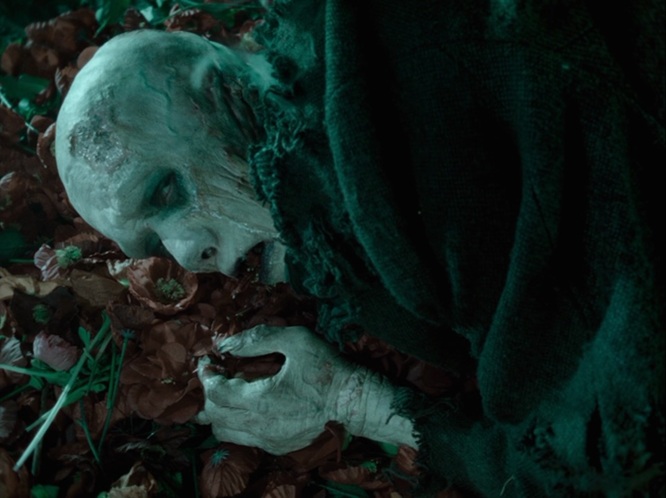
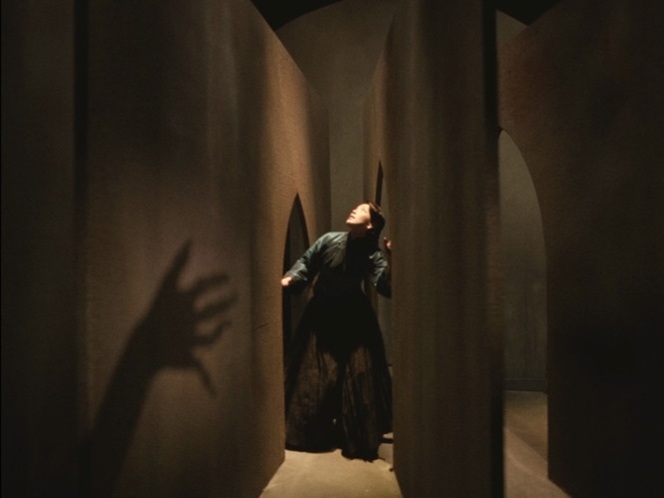
:: Jackson Yee (Deliriant) // Shu Qi (The Big Other)
Put differently, there is a feeling that Bi Gan has always cast his shadow over the film, but his artistic intentions are only to be felt and accepted, not pondered. Thus, this nostalgic science fiction constructs an intricate system of contradictions, in which everything is predetermined, incontestable, yet incredibly vague, all the while the concept promises a world-building story. This paradox is made obvious in the opening chapter, as it forces a near-death body into dreaming. Resurrection gives us an image of the hollowed-out thought as an ended dream, a backward journey to a dead end. As such, the Deliriant’s journey is inevitably comparable to the odyssey of Magellan, whose colonial conquest ended up in death, and Lav Diaz’s Magellan uses oil painting texture and stoic movements to match the breath-less past tense of history, the necropolitics of colonialism [4]. Resurrection’s personification of cinema, similarly, would have required a matching cinematic subjectivity that would have decentered Bi Gan’s commentary on film history.
If we think of David Lynch’s works that Bi Gan seems intent on resembling (the craft-like set designs, the mysteriously peculiar strangers in the story, the quirky looks of “another space and time”—all signifiers that fail to capture what is truly special in Lynch’s work but are nevertheless featured in Bi Gan’s A Short Story [2022] and subsequently Resurrection),we see a significant difference in attitude towards its audience, and a belief in their capacity to engage with their respective works. Take, for instance, the fact that we can clearly see Miriam Sullivan (Sarah Jean Long) breathing after the brutal attack by Richard Horne (Eamon Farren) in Twin Peaks: The Return (2017) carelessly pulls us out of the world that cinema is capable of building. This moment makes us wonder whether it was an error or intentional for Miriam to be breathing after she was supposedly killed by one of the most violent characters in the series. The breathing actor is the signal cinema sends to its audience, giving away the action of cinema as a writing gesture. Furthermore, the breath metaphorically anchors cinema’s subjectivity—here, the creators entrust cinema and the audience to build a fearless connection, as the creators of Twin Peaks: The Return seem as bewildered as we are by the ineffable mystery of that world (whether the “good” will survive the attacks of the “bad”), which ultimately brings that world and our reality together. Breathing or breath-less subjectivity, quite literally in the examples of Magellan and Twin Peaks and metaphorically in general, corresponds with the attitude of the works. The double deprivations of diegetic subjectivity and audience subjectivity in Resurrection, through its calculated and arbitrary presentation of film history, communicate little more than a genuine fear of expressing anything concrete about a contextualized history of real blood and tears. A fear of the audience recognizing reality, and a fear of letting its characters breathe.
If the nuclear bomb in Twin Peaks: The Return is also a piece of technology like cinema—an extension of the human gesture and a site of collective memory—the show presents us with the responsibility that technology entails. Technologies as actions have consequences, and so does cinema. So, by removing the subjectivity of cinema, Resurrection indulges in a negligence of responsibility and proudly collects disinterest toward consequences. Taught and used by the Deliriant to swindle others by way of her ambiguous superpower of smelling information from paper, the Little Girl (Guo Mucheng) actually does so when she is kidnapped. She is asked to smell and tell what was written in a burned letter, and we hear her announcing the first two lines. Then, the film cleverly and confidently cuts to a tilt-up to the tree crowns, recalling the style of The Tree of Life (Terrence Malick, 2011); except that here, the sudden vitality of the camera movement is insufficiently prepared and out of place. The film leaves the child behind, as the Deliriant did—both actions without consequences.
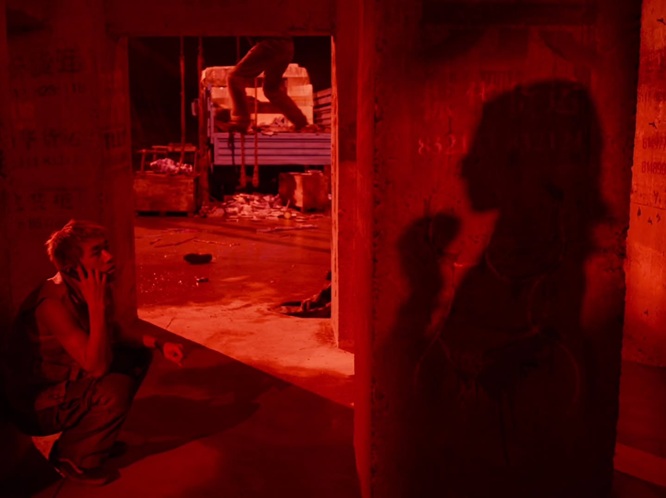
:: (Left) Jackson Yee (Deliriant / Apollo) // Shu Qi (The Big Other)
Intensified by the film’s lack of cinematic context, as it safely veils its relevance to reality with the science-fictional futuristic past (illustrated through the opium dens and Shu Qi’s Republican-era costume) and its exploitation of repeated resurrections, the gaze of the film looks back, rather than projects forward. Thus, Resurrection presents a reversalof the history of cinema as a technology, a technology that should embody the lifeworld of creating rather than the death-work of summoning. It also presents a reverse journey from the one in Leos Carax’s Annette (2021) (Carax seems relevant to this film, both thematically and formally, owing to Bi Gan’s visual maximalism and meta-reflections on cinema); instead of animating/enlivening its cinema-puppet-character over the course of the film (as in Annette), Resurrection can only redeem its slow, boring killing through its title. The film seems to be fighting an overpowering sense of constraint (perhaps state censorship) and an irrational urge to whitewash its own logic at all costs, which is sympathetic at best, because Bi Gan’s collectioneurexhibition of styles and techniques makes his mourning and adoration of cinema feel like little more than ostentatious, pessimistic posturing.
Dismissing any interaction between cinema and the world, Resurrection is ironically legitimate only with the complicity of an audience willing to celebrate the death of cinema. To reconcile ourselves with its bleak imagery, we must carry the entire intellectual weight and prove our cinephilic expertise to justify the work. In other words, the film is almost entirely made in the watching, and this is the furthest that referential cinema can go. In no way is this a reflection of cinema’s destiny or current state. If Resurrection says anything about film history, it is that the capitalist drive and the ignorant fetishizing of a certain Chineseness—perhaps more accurately a lack thereof—and the referential discourse of global art cinema of this era are more interested in self-destruction than in reparation. This tendency is merely more prominent in today’s meta-cinema. The discourse’s obsession with recycling iconography is just one of many symptoms of this slow-moving disease that wishes to kill cinema by concurrently killing its history, and posing to cry over it.
[1] In Cinema Illuminating Reality (2022), Victor Fan draws connections between cinematic senses and Buddhism.
[2] Vivian Sobchack’s idea of cinema as an embodied experience seems to be a foundational methodology for Resurrection’s story. Wang Xinyuan discusses this in depth in the article “Cinema Disembodied?: Bi Gan Revisiting the Death-of-Cinema Cliché with Resurrection.” See Senses of Cinema. https://www.sensesofcinema.com/2025/feature-articles/cinema-disembodied-bi-gan-revisiting-the-death-of-cinema-cliche-with-resurrection/.
[3] Tom Gunning wrote on this in “Cine-Graphism: A New Approach to the Evolution of Film Language Through Technology” (Technology and Film Scholarship, p. 195–211), in which he examines early cinematic technology in relation to film language as an alternative way of engaging with film linguistics, rather than through the semiotic analysis of film texts. It is argued that cinema, as a technology, is similar to writing, with both “exteriorizing human processes of perception and language in a form of technological memory”.
[4] The film also premiered at Cannes in 2025.
Images from Resurrection (2025), © Huace Pictures, Dangmai Films, et al.
*
Chuiwen (Wen) Kong is an independent filmmaker and writer. She recently received a Master's in Cinema and Media Studies from the University of British Columbia, where she defended her thesis: a video essay titled "Wang Bing’s Youth trilogy: repetition, gesture, and sentence image in Chinese cinema."
 |
envoyer par courriel | 
| imprimer | Tweet |





Site créé sur mesure pour Panorama-Cinéma par  .