|
Symbolic Analysis Clint Enns |
|
Introductory Remarks Stephen Broomer |
In the 1960s, a great many young North Americans began to suspect that they had been educated for the wrong life. From the campuses to the suburbs, modern consumerist society began to show its conformity in an ugly light. So the young went looking for other forms of permission, and found it in the instructional and self-help literature of the era. Paul Goodman asked what kind of society could expect its children to grow up honourably when the available forms of work, public life, and community were flaked so thin. Norman O. Brown extolled civilization as a long history of repression, a war of the official self against subsumed, buried energies. In the work of Arthur Janov, there remained some original wound beneath the habituated composure of civilization. Beside these books, and often in the same rooms, lay the practical literature of a counterculture that was planning an exit: The Whole Earth Catalog, organic farming guides, shelter manuals, food co-op instructions, plans for geodesic domes, pages on compost, bread, midwifery, printing presses, hand tools, edible plants, and solar heat. The instructional literature of these years confirmed to its reader that their lives had been badly instructed from the start.
The Back-to-the-Land movement was a migration from city to bush, from apartment to farm, but it was also a migration between pedagogies. The manual and the self-help book arrived in the same rucksack. Goodman’s Growing Up Absurd, Brown’s Love’s Body, R. Buckminster Fuller’s Operating Manual for Spaceship Earth, mimeographed recipes for whole-grain bread, an organic gardening handbook, all belonged together as a half-finished curriculum. Its apostles were approaching the land by way of print to regain knowledge they ought to have inherited. A youth trained by institutions was trying to regain Paradise through books, catalogues, diagrams, guides to recover old skills. They were learning how to eat and build and plant, and in the same breath, how to heal and touch and love, how to raise children outside the structures that had brought them up.
Keith Lock’s 1975 experimental film Everything Everywhere Again Alive belongs to this culture of self-instruction. It is neither an educational film nor a filmed diary of communal life, although it has, too often, been described as a diary. This shorthand comes easily to it, because it’s a film of Lock’s time at the Buck Lake commune, represented chronologically, and because it watches the evidence of days: farming, cooking, the awkward ceremonies by which the communards build their settlement. But a diary records the passage of a self through time, while Lock’s film is more interested in the ways that time educates the self. Its typed words, perforated circles, dots, numbered frame corners, freeze frames, colour disruptions, fragments of speech, are not decorative modernist gestures laid over a domestic vision. They are part of the film’s instructional constitution. In Everything…, Buck Lake becomes a site of retrained perception. Lock’s film presents us with the seasons and the cycles of time far from rush hour; it offers us homesteading as a psychic practice. It is less a diary than a notebook responding to The Whole Earth Catalog as a template for living-otherwise: Lock charts signs through which living-otherwise might be apprehended from within. The film teaches attention and, in doing so, it embodies the hope that a life can be remade by learning to read the world again.
What follows is a taxonomy and analysis of symbols drawn from Lock’s film. These images were printed into the film by way of optical compositing and, as such, they should not be misinterpreted as stray or casual markings, but as a sign of the film’s transgression from the diary or the home movie, acts that distinguish it as a work of authored construction. This also means that these images were added after-the-fact, that Lock deliberated on the footage and arranged these impositions as signposts of what he had experienced, as guide work, as a clarifying force or a counterpoint to the action on screen. They may resemble at times drafting indicators, like grease-pencil marks meant to be scrubbed away, but they are always placed with precision and force. In this sense they are closer to the hieroglyphics of hobo signs, cut into trees, chalked onto steel, to inform fellow travellers of opportunities and threats. What Lock is doing lies closer to the spirit of the instructional literature of the era, to almanacs, to practical knowledge, than it ever could to a diary, even as its ornamental, visual disruptions, the extraordinary precision of his camerawork, and his lyrical meditations on the seasons, set Everything Everywhere Again Alive in the convictions of art.
*
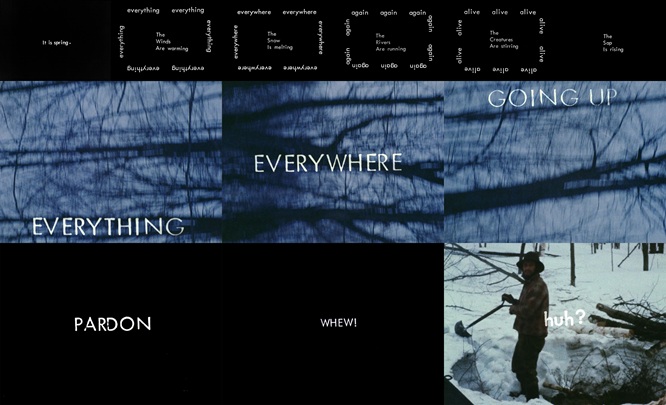
An introduction to the title of the film through poetry. At Buck Lake, spring is here and everything is again alive—everything is coming to life, everything is rising. It is a serious film that promises not to take itself too seriously.
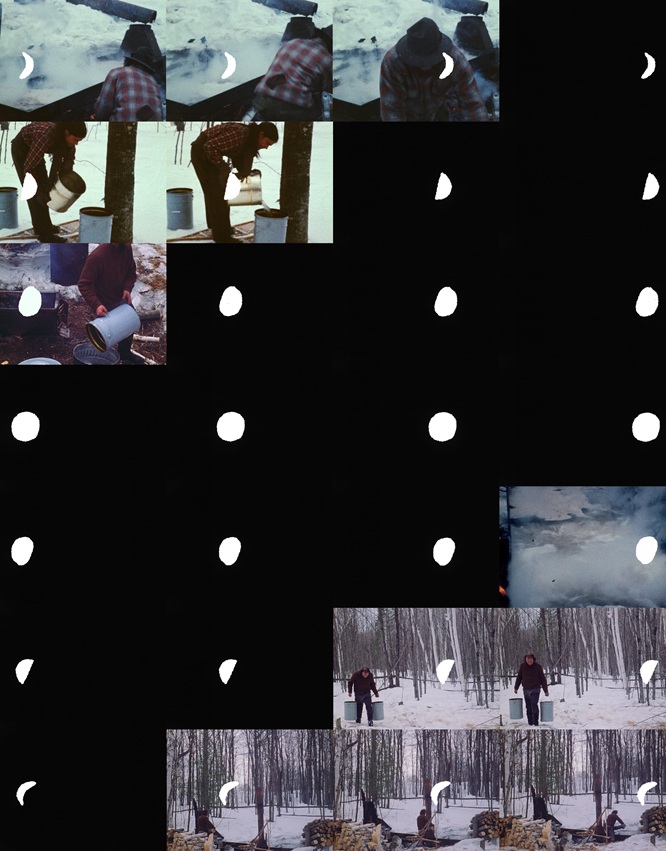
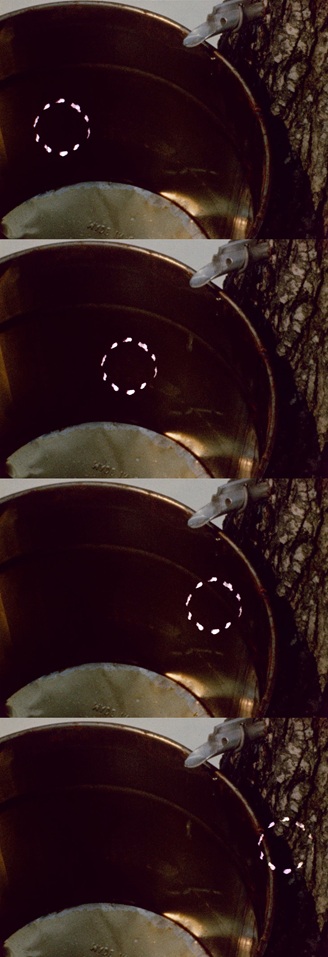
The cycle of the moon repeats across the frame marking darkness and light. The slow work of early spring. Pouring sap, carrying buckets, and tending to a revitalized world, labour that belongs to a larger cycle.
|
|
|
|
|
|
|
|
According to Keith Lock:
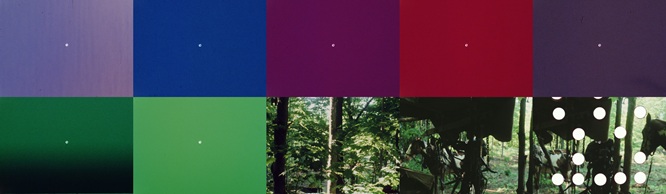
One of the symbols I used in this film is a small circle, which is the letter “o” created on a typewriter. I used this because, as zero, it is the symbolic signifier of nothing. As a circle, it also signifies the cyclical seasons and the idea of completeness and totality.
The circle is present throughout, a recurring dot at the centre of the frame. The circle can represent both zero and eternity, like the Ouroboros, an infinite circulation of destruction and rebirth. It is a modest mark, almost negligible. As a circle, it folds back on itself, suggesting recurrence: seasons turning, cycles completing, a form of wholeness. It is also a focal point, a meditative anchor. The eye settles on the middle of the screen. As such, the “o” functions less as a symbol to decode and more as a form of mediation, a way to concentrate our focus.
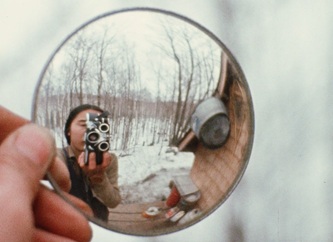
The circle is also the filmmaker reduced to a point, the filmmaker’s impression. Later in the film, we see him holding a Bolex reflected in a small hand-held circular mirror in the centre of the frame.
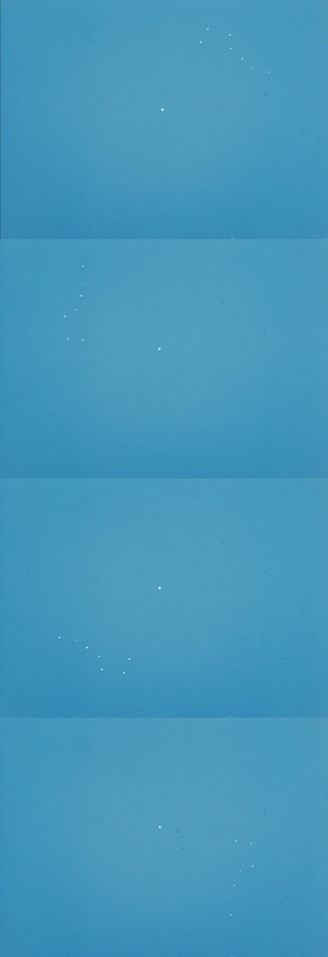
The colour fields interrupt the film with equal insistence. Since the film was shot on a Bolex, each take is constrained to 30 seconds. The blocks of pure colour emerge in the gaps, the intervals between filmed events. This is where the film leans toward the Dào Dé Jīng [Tao Te Ching]. Presence and absence become mutually defining conditions. If the documentary images are events, the monochromes are the breaths between.

A random key code provides a structure. A local farmer is held by a freeze frame. It is not only the camera that imprisons the subject, but the filmstrip itself.
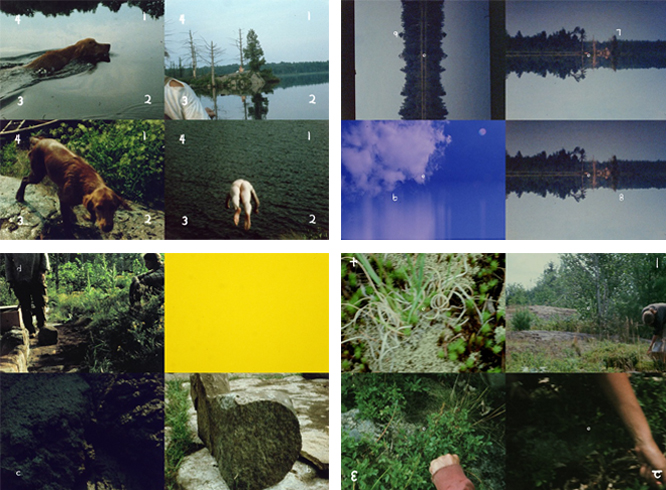
The letters, numbers, and abstract mathematical symbols at the corner of the screen are not simply symbols, they represent entire systems. Just as we see the laying of a new foundation for a home, we are introduced to these symbols which lay the foundations for new forms of thought. Starting over isn’t just physical, it is conceptual. A recalibration at the level of thought. If the old structures of thought no longer hold, then new ones have to be assembled from their smallest units. A manual for rebuilding the world from its most basic codes, step-by-step instructions for rebuilding your life.
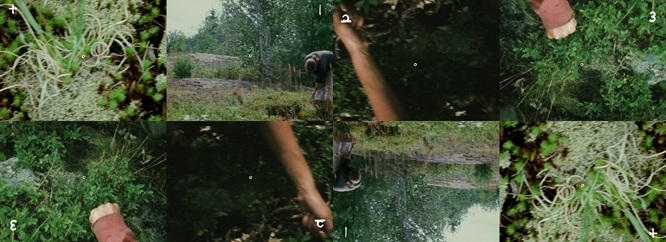
The poetry of abstraction:
1
Walking over pink granite.
c̄
Crouching and putting blueberries into a basket.
ε
Blue sky. The sun’s heating. The sun heating my back.
+
Sitting down on a rock to rest.
When each of these symbols is rotated around the centre, a more familiar form is revealed.
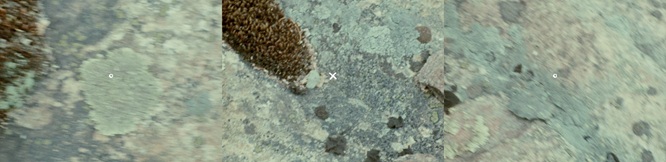
o x o
Wind and Trees
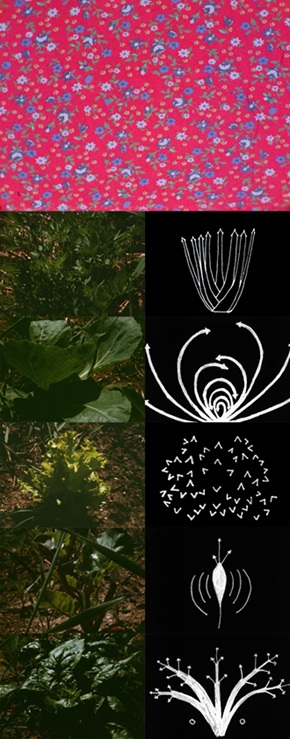
Chalk drawings of plants are intercut with scenes of gardening; these images suggest a self-consciousness on the part of the filmmaker, a contrast of the vitality of the living organism with his filmed record of it; the illustrations become one more degree removed from the image. Lock’s approach reinforces these growing distances, from representations of plants on fabric, to the empirical experience of tending to these plants, to the act of recording them, and further still, to the act of illustrating them.
|
Used in traditional medicine and as an herb in cooking, though bitter. Historically associated with protection and warding off evil spirits.
Rhubarb [Rheum rhabarbarum]
Primarily grown for its edible, tart leaf stalks, which are used in pies, jams, and desserts.
Lettuce [Lactuca sativa]
A staple leafy green vegetable enjoyed worldwide for its mild flavour.
Beetroot [Beta vulgaris subsp. vulgaris]
Cultivated for both its edible root and leaves for thousands of years.
Spinach [Spinacia oleracea] Rich in vitamins and minerals, a nutritious leafy green vegetable. |
|
|
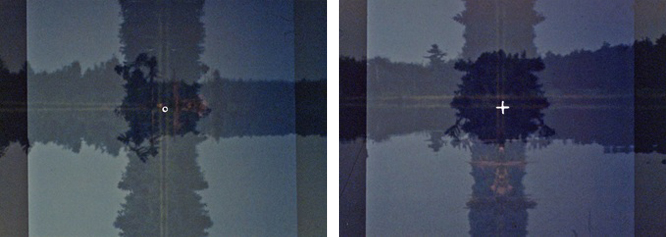
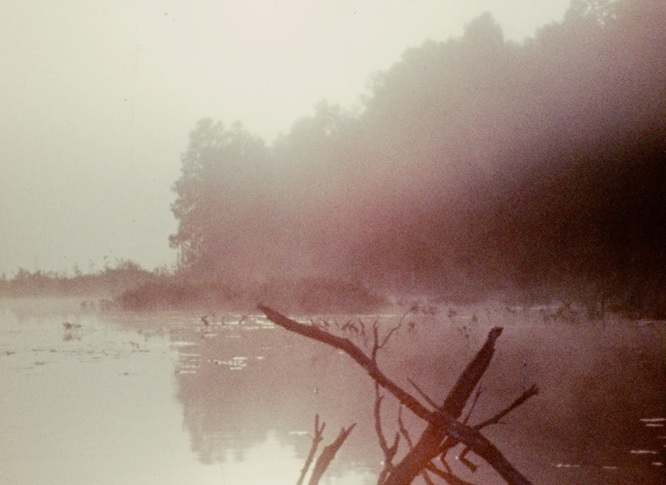
A superimposition of a world rotated around its centre, the “o.” The tree-lined horizon of Buck Lake is fully rotated 90 degrees, and then another 90 degrees, turning the image fully upside-down—or is it right side up? Lock is playing with the symmetry of the image, casting uncertainty as to which tree line is real and which is the reflection. This, again, resonates with Lock’s theme of the distance between true empirical experience and the inscription of it. This horizon is another participatory opening, an opportunity for the viewer to explore their own subjectivity, the tree line becoming like a Rorschach Test inkblot.
|
|
|
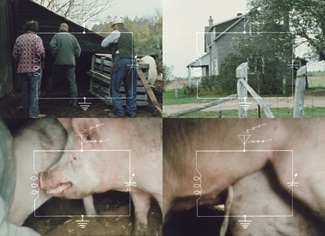
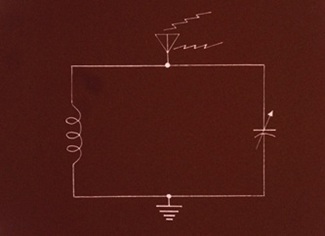
Antenna (top):
Variable Capacitor (right):
Inductor/Coil (left):
Ground (bottom): By adjusting the variable capacitor, you change the circuit’s resonant frequency. When the resonant frequency matches a radio station’s broadcast frequency, the circuit oscillates at maximum amplitude, “tuning in” to a specific station while filtering out others.
|
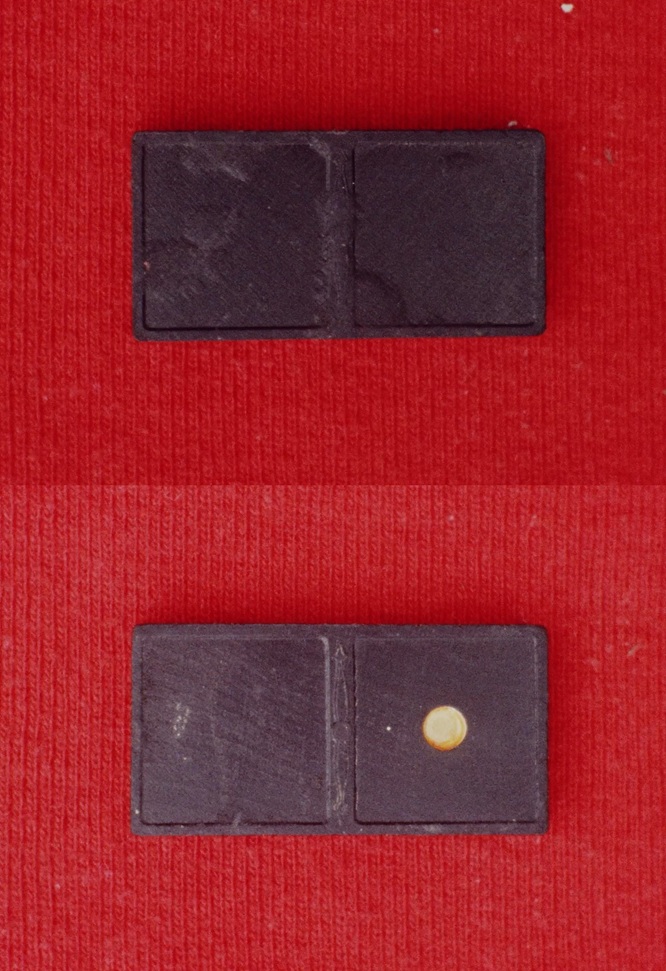
As Keith Lock explains:
The theme of something and nothing is central to the film. We see pigs mating, followed by a blank domino, followed by a domino with a single dot. The pig licking the goat’s ass doesn’t distinguish between shit and food. It is all food.
From this, we see that Lock is as an optimist. If he had not been, he might have said it’s all shit.
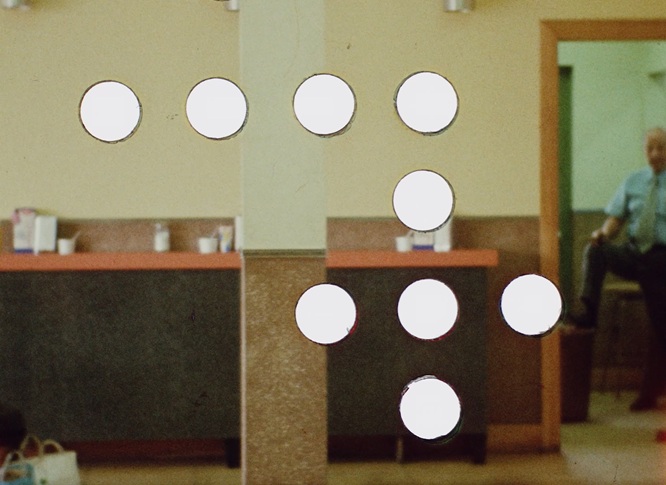
A piece of the key code. This one wasn’t isolated through step printing, but it appears on a reel associated with downtown.
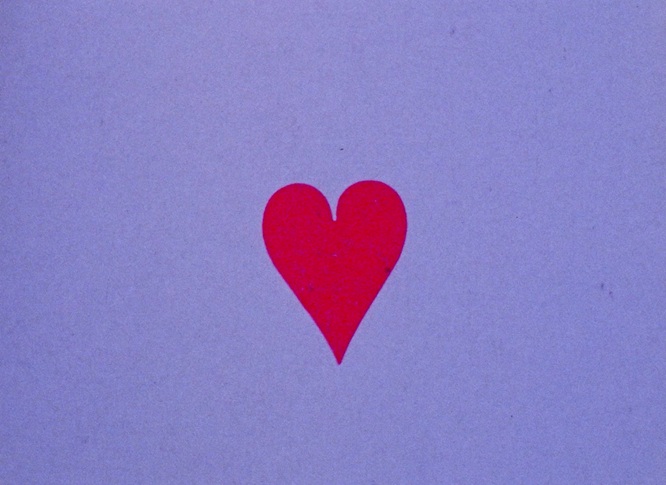
Keith Lock on love:
― I had visited Buck Lake with some of the people living at the house on Roxborough Street. I had been totally entranced by the place itself and the possibility of creating a new society based on love, personal freedom, mutual respect and living close to nature.
― There was never any manifesto and we never tried to discuss or define it, but we just knew who we were and what we were about—no possessions, love, sharing, honest physical labour and staying close to nature.
― I’m not really clear about how falling in love might have affected the films I made, or the “revolution” at Buck Lake, but I think it was possibly profound.
― “Mom, it’s not who you love, it’s that you love.”
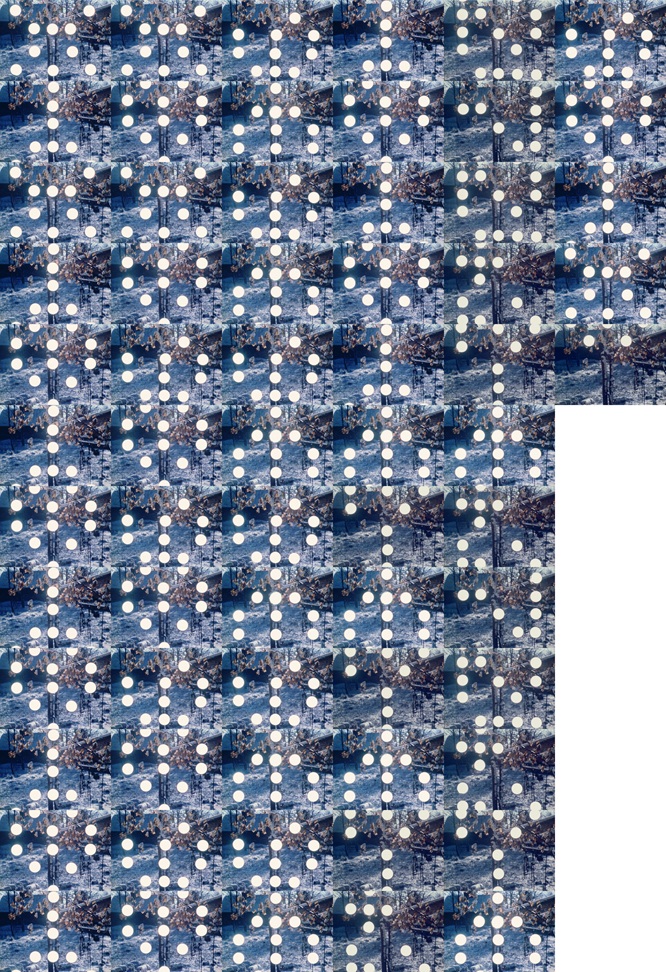
A segment that weaves together one section of the film’s key codes.
|
|
|
Little Black Box |
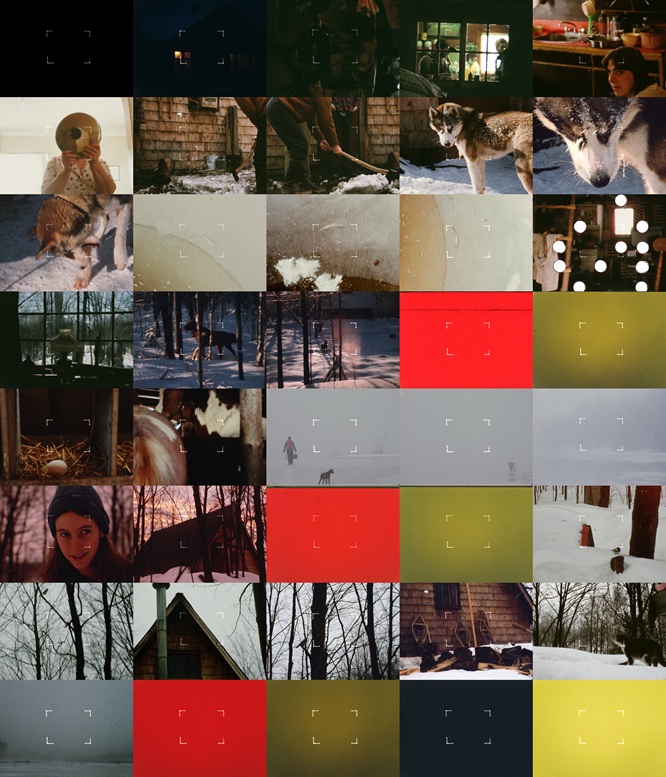
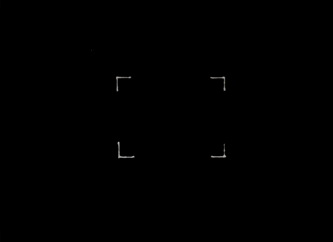
Each image is a framed reality. Square brackets are superimposed over the image, drawing attention to Lock’s framing in such a way that resembles the framing guides common to the interior of a camera eyepiece. We are reminded that not everything can be shown, leaving the obvious question: What’s inside the frame and what remains outside of it?
|
|
While the documentary aspect of the film might suggest cinéma-vérité, the filmmaker and his camera remain at the centre of the film. Like the “o” seen earlier, the filmmaker sits at the core of the film. This subjectivity is always present, whether acknowledged or not, it is impossible to ignore. The idea that the camera is objective is a myth.
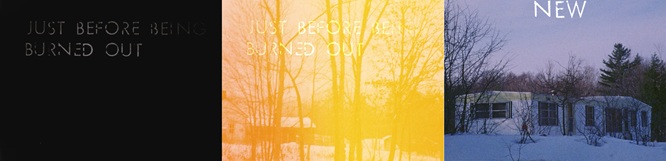
A statement that potentially holds three meanings in context. It could reflect the director’s own state, the filmic burnout at the end of a roll, or a lived reality…a house destroyed in fire, replaced with something new.
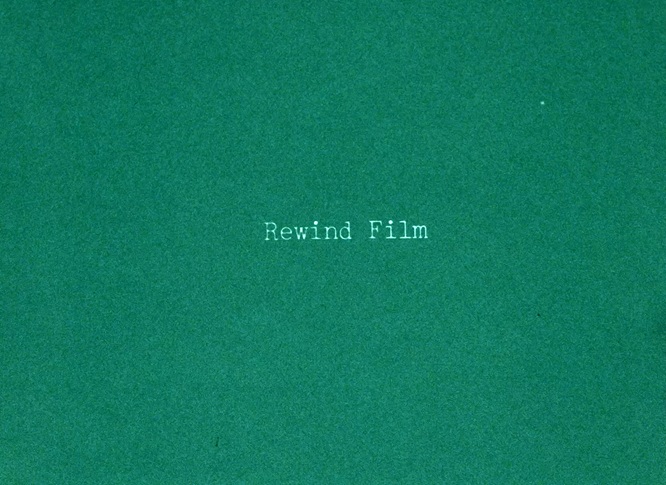
Lock’s ending suggests that everything, everywhere is a never-ending cycle. The film ends with an invitation…to rewind, to begin again, to re-examine our foundations, to test old ideals against hard ground, to question the cycle itself, to ask whether returning to the land frees us from the loop or establishes new ones.
Stills from Everything Everywhere Again Alive © Keith Lock, 1975
*
Stephen Broomer is a filmmaker, film preservationist and film historian. He is the founder of Black Zero, a home video label dedicated to Canadian underground cinema, which features Everything Everywhere Again Alive among its inaugural releases.
Clint Enns is a visual artist, writer, and curator living in Tiohtià:ke / Montréal.
 |
envoyer par courriel | 
| imprimer | Tweet |





Site créé sur mesure pour Panorama-Cinéma par  .
.