
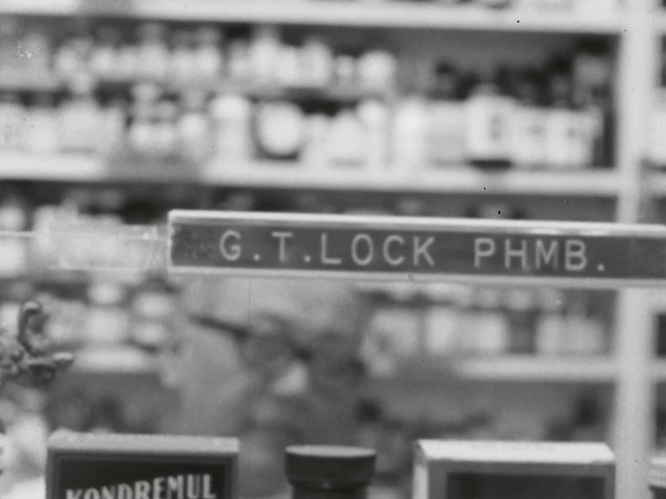
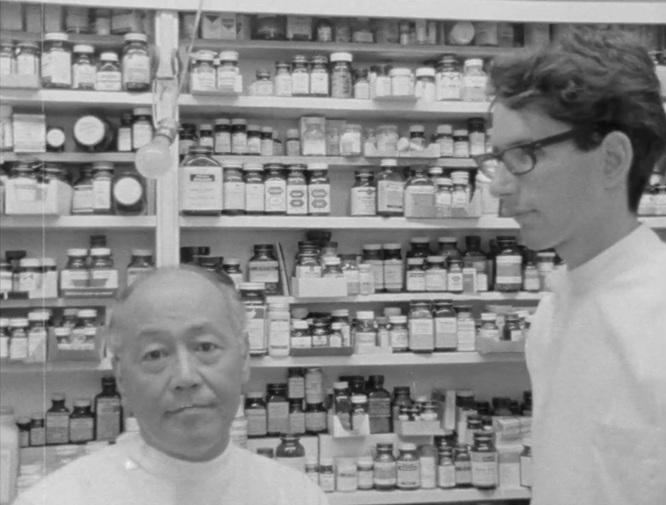
:: Arnold (1971) // Tom Lock and John Turnbull in Work Bike and Eat (1972) [Keith Lock / Jim Anderson]
“G. T. Lock”—reads the name card of the Chinatown drugstore owner in Keith Lock’s two films starring John Turnbull: Arnold (1971) and Work Bike and Eat (1972). The camera lingers on his face a little too long, after he tells his clerk Arnold (John Turnbull) to “never send your customer to another drugstore,” and the authentic frustration and fleeting moment of confusion on his face secure a laugh from the audience. The Toronto Chinatown under Keith Lock’s camera is too real, its non-professional Chinese actors too humble and funny, and always properly relaxed. And these Chinese faces behind the protagonist’s absent-mindedness and innocent eyes in the two films—a short comedy and an improvised medium-length film centring on the life vignettes of the young employee at the Chinese drugstore—compose what experimental filmmaker Rick Hancox calls “the original slacker film” (on Work Bike and Eat).
Going from these playful black and white images down the river of time, the cinematic journey with Keith Lock is more of a legacy cinema of the Chinese Canadian diaspora, than a diasporic cinema by definition. Himself a third-generation Chinese Canadian, Lock inherits the diasporic memory and transforms it with an incredibly easy directness in his art of storytelling. With this ease, he portrays the constant struggle of assimilation and affirmation of one’s culture, the everlasting shifts between shame and pride, and the inevitable coexistence of hope and loss. These experiences, central to the diasporic community, are otherwise ineffable if not for his films’ impressive belief and ability to leverage the cinematic medium.
If we trace back the river of time, watching Keith Lock’s works, over his nearly six decades of filmmaking, becomes a journey of revelation. The name Tom G. Lock would undoubtedly ingrain after watching Relics of Love and War (2023), so its appearance in Work Bike and Eat becomes comforting and, at the same time, greatly saddening. This unique opportunity to watch these films altogether is indeed a gift and a challenge from time: amidst the immense sense of loss, we are able to collect clues and bonds that are defining to a cinema of memories.
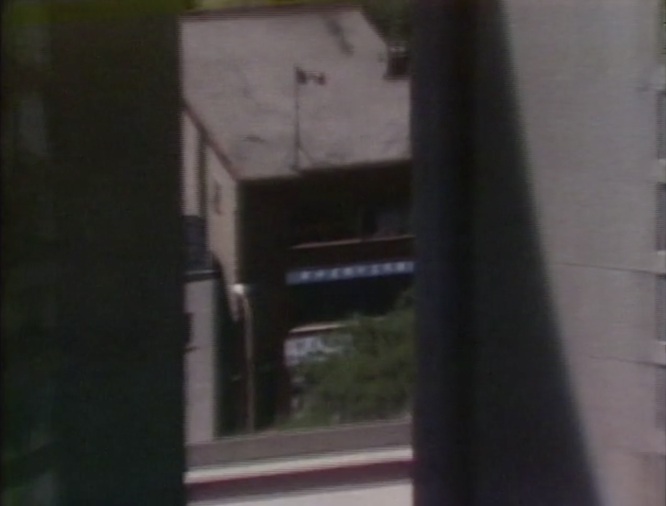
Tom G. Lock, the owner of the Chinatown drugstore, walks slowly pass the house he was born in, pushing his granddaughter’s stroller in The Dreaming House (2005). Between this and Work Bike and Eat, more than ten years after Tom appeared in the “slacker film(s),” Keith Lock shoots Chinatown in colour for the first television film about the Chinese Canadian community made by a Chinese Canadian. The host Valerie Mah visits a reading room that appears in the thin gap on the newly constructed city hall building, in a bizarre DV zoom-in shot. Walking into the empty room with a big table, where newspapers still cover the entire surface, she leans against the table, with bright windows against her back, to explain that this was once a space where the Chinatown workers gathered after their long workdays to catch up with the news. Chinatown (1984) shows us the fascinations and shocks you would find in Chinatown. It is a contemporary introduction, with the liveliness and resilience of the community as well as their ongoing struggles against gentrification and demolition.
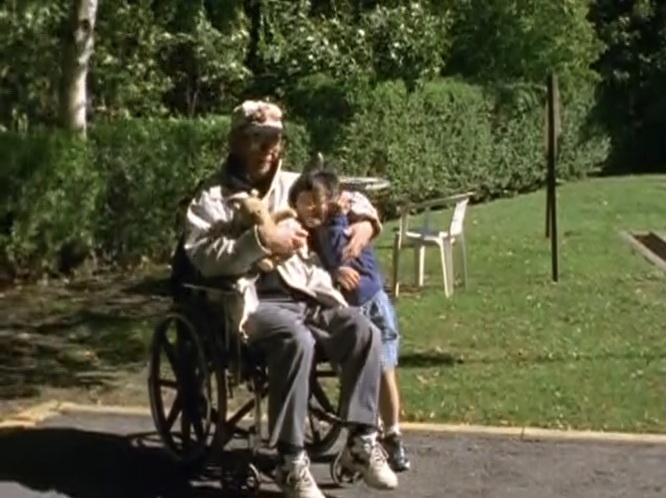
In Keith Lock’s films, the containers of history are almost always affirmatively shown in their contemporary state, where historical images leave their invisible brushstrokes. In these films, there is almost a resistance to nostalgia by the limited use of juxtapositions of different times; Lock shows us the present and the present primarily. In a way, his films define an undeniable forward momentum of living, in the sense that it captures the renewal ofvitality and the passing of time instead of just vitality and time themselves. In Chinatown, they are the recollections of the early immigrant and the interview with the teenager, the shots of the children and the elderly, and the conversations on computers and reproduction. In The Dreaming House, Lock’s father sits in a wheelchair, and his granddaughter hugs and leans on him. The images of Lock’s father’s birthplace and his father are patiently shown only in their present forms; the drugstore owner in the cinema of 30 years ago exists outside of the film and the film’s time. As such, the absence of visible juxtapositions of the subject’s current and previous states in Chinatown and The Dreaming House forms the elliptical essayistic style of Lock’s non-fiction works. In his cinema, memory is manifested by concrete objects, locations, and habits, instead of abstract recollections. These are the direct qualities of his films. There are very few cross-cuttings, no going in and out of memories, no recreations or reenactment of the past, or the weaving together of memories and present like a maze. Time has to be restored to its linearity, because it is used as a measurement for the inexplicable chances and coincidences of existence.
 :: Chinatown (1984) [CBC]
:: Tom Lock and Keith Lock’s daughter in The Dreaming House (2005) [Wondrous Light]
Chinatown and The Dreaming House’s lucid grasp of the now and here stems from the deep familiarity with one’s diasporic history. In other words, Lock’s films put forward how the certainty of the past overrides the hesitations of interpreting it. One well-cherished and repeated recollection of the past is enough to conquer the many efforts of erasing, underrepresenting, and the risk of deciphering this difficult and often forgotten past of the Chinese Canadians. Equipped by familial connections and his persistence in picking up the camera, the past never mystifies itself in Lock’s cinema. In his films, we see some of the most confident, and therefore astonishing, renderings of the past. In Relics of Love and War, the story of Lock’s parents’ works and meeting during their secret works in World War II, during the time of “life sentence to loneliness” enacted by the Chinese Exclusion Act in Canada in 1923, was narrated by Keith Lock in a personal essay perspective [1]. Almost entirely made up of black and white photos he recovered from family and war archives, except for the opening and the last ten minutes of the film, the past stands on its own feet; it was not mediated through the present. It reuses photos, zooms in on them, and even explains the size of these photographs: one of the letters Lock’s father sent to his grandmother was photographed and transformed onto 16 mm movie film for the efficiency of shipping in large quantities with other veterans’ letters. It resonates with the style of Bianca Stigter’s Three Minutes: A Lengthening (2021), which stretches a 3-minute home movie to 69 minutes to investigate the happenings of 1938 in a Polish town before the Shoah, both demonstrate the total trust of history’s depth and density.
By its very form of austerity, Relics of Love and War acknowledges the fact that this history can only be “approached,” not entirely unveiled. So the photos, in their obscurity, rather accurately and vividly narrate the dilemma of these Chinese Canadians’ work and life: in the time of discriminations and exclusion, Lock’s father and his fellow Chinese Canadian soldiers trained, lived, and worked for their country, and hoped for change and recognition for their collective future, while swearing their war activities to secrecy for 50 years. Among the many other photos, one picture of Lock’s parents walking with their bikes towards the camera strikes me with its subliminal transcendence of love and time—they were captured as newly-weds who met just four months before, in a moment of daily life. This photo is a testament to their strengths and victory against the life sentence to loneliness.
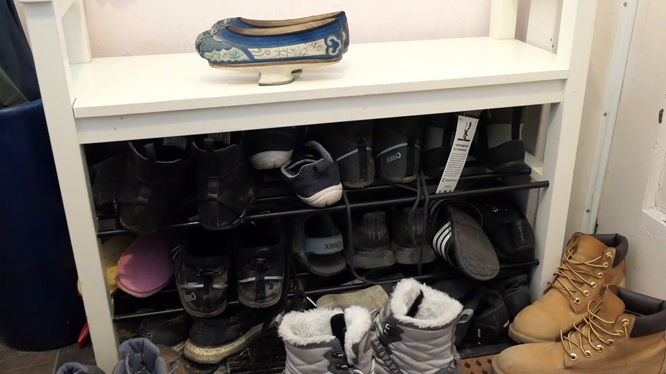

:: Relics of Love and War (2023) [Wondrous Light]
Relics of Love and War’s opening chapter has this simple image of Lock’s grandmother’s Qing-style shoes on the platform above their shoe rack in the entry way; Lock narrates, “shown here is the typical Asian front door shoe collection.” His grandmother’s shoes, their silk surfaces shining faintly, still possess a humble shade of blue. Towards the end of the film, the bullet shell Lock picks up on Commando Bay (where his father secretly trained), after the thorough clearance conducted by a research team, is a miracle of an object that reminds the filmmaker of a real, yet inaccessible past. In a way, the solid linearity of time in his films is a surrendering to the unshakeable passage of time, the active confrontation to loss, that while the objects may remain, his father and mother were long passed. How could one not be overcome, when confronted by the unbearable and irreversible separation from the bodies of their loved ones? How could one play with time when the familial memory becomes a personal memory, when a shared oral history becomes a lonesome journey of storytelling?
If we return to Lock’s earlier works, in Work Bike and Eat, time itself is the ritual. The rhythms of a family meal and a silent race between two bicycles competing to get a more advantageous position before the light changes to green are choreographed into dances and incorporated in the larger musical landscape of the film, which points to the diegetic piano. The musicality of banal movement is not a decoration of everyday life, but again an impulse of materialization, of finding a concrete source—a style of memory in cinema.
Near the ending chapter of Relics of Love and War, the film shows the streets of Vancouver in current times, and Keith Lock repeats his narration from the opening of the film: “Which memories do we discard and which memories do we take with us?” At this moment, the camera is effectively looking (and shooting) the places afterthe events. In a way, it’s like we are destined to shoot empty frames. In Arnold, the camera pans left and right, but is always a second too late in catching the protagonist in the shot. This is the melancholic, always losing battle of cinema. Whether it’s the secret training of Operation Oblivion in Commando Bay, the house where an old man was born, or Arnold sweeping the floor, the camera is always slightly too late. But what better expresses the fearless flows of love across time and space than the brave materialization of the past, through photo negatives, Chinatown houses, and picking up a bullet shell, in this quiet surrender to time? Jean-Luc Godard says, in Histoire(s) du cinéma (1988), “Si un homme traversait le paradis en songe, qu’il reçut une fleur comme preuve de son passage et qu’à son réveil il trouva cette fleur dans ses mains, que dire alors ? J’étais cet homme.” If we live in this world and something has to be the proof of our passage, it’s these empty frames that cannot document the secret mission, or the panning shots that cannot catch Arnold, that are shot, kept, and shown anyway. “How do we take with us memories by those whose duty was to leave no trail?,” Keith Lock asks in Relics of Love and War. In a way, he solves it in his film. It is the courageous evidence of love and war, the decision to look back and map the past to the present, knowing that we might never be able to fully see the past, knowing it’s forever unreachable by touch. Lock’s objects are the flowers that remain in our hands. And when life passes through us, cinema shows us how we take memories as the most concrete and the most transient.
[1] The secluded nature of Tom Lock’s secret mission and the scenery of the training site reminds me of the D’Arcy Island Leper Colony, an island off the coast of Victoria where a handful of predominantly Chinese men with leprosy was left in forced isolation between 1891 and 1924. Island of Shadows (2000), a film by Erik Paulsson, is about this history.
*
Chuiwen (Wen) Kong is an independent filmmaker and writer. She recently received a Master's in Cinema and Media Studies from the University of British Columbia, where she defended her thesis: a video essay titled "Wang Bing’s Youth trilogy: repetition, gesture, and sentence image in Chinese cinema."
 |
envoyer par courriel | 
| imprimer | Tweet |





Site créé sur mesure pour Panorama-Cinéma par  .
.