
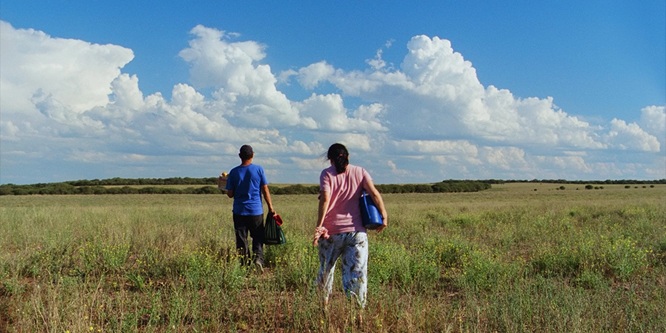
Lisandro Alonso burst into cinema with an uncompromising slow cinema feature called Freedom (La Libertad, 2001). With long takes and an observational approach, it followed non-actor Misael Saavedra, a wood cutter the director had met by chance. It became a sensation in Cannes at the time, and paved the way for each of the Argentinian director’s films to be presented there.
Eight years later, Alonso worked on a project with Spanish filmmaker Albert Serra that saw both returning to an earlier work in order to make a pair of short films that were collected under the title Sinergias: Diálogo entre Albert Serra y Lisandro Alonso (2009/11). For Alonso’s short, Untitled (Letter to Serra)(Sin título [Carta para Serra]), he contacted Misael Saavedra again and, together, they revisited Freedom.
This year, Alonso has returned again to his first film to produce Double Freedom (La Libertad Doble, 2026), fiction that looks like documentary. This patient parable centres once again on Misael Saavedra, an Argentinian lumber worker who is accompanied only by axe, chainsaw and dog. He lives in a doorless hut where he cooks armadillos over a fire. Just like in his first feature.
This portrait of economic precarity is set in what Buddhist monk Thích Nhất Hạnh called the most sorrowful part of the day. In the global south, this is early afternoon, when “there isn’t a voice to be heard. There isn’t even a thread of wind, and the trees are still as corpses.” [1]
Twenty-four minutes into Double Freedom, the first words. A greeting to his neighbour building a fence. “Good afternoon, sir.” But this is not a fence that separates, it brings them together. Misael chips in to help right away.
Cinema is an art of time. Time is one of its primary materials. In artists’ movies, this material can be stretched or squeezed, producing impressions and frames that rush by too quickly to see, or else slow enough to see a man eating a few mushrooms for half an hour, or the way leaves move in a tree. Here, we are invited to live in the body of Misael, a man who lumbers slowly across a familiar landscape, pausing often. We learn to wait with him. By feeling how he experiences time, we are transported to a country and culture very different from the one dominated by the Internet and its restless, addictive flow.
Misael is summoned to a mental health hospice where his sister Micaela has been living for the past decade and a half. They no longer have enough funds to house patients, so families need to take them back. Everyone is on the same strong drugs that “boil the brain.”
The spare down tempo life of the wood cutter is a prelude to Micaela’s world. When we meet her, she is absorbed by an open window. The portal, the border between inside and out. One of her superpowers is the ability to merge with what she’s experiencing, as if the tragic separation of human and animal, human and world, which has led to our present climate catastrophe, has been eased, even erased. Micaela’s borders are soft, like the “house” of Misael. Everywhere she carries her water pot. Mother of all plants. The larks sing to her in welcome. She has a long meeting with a tree, they stand and then dance together.
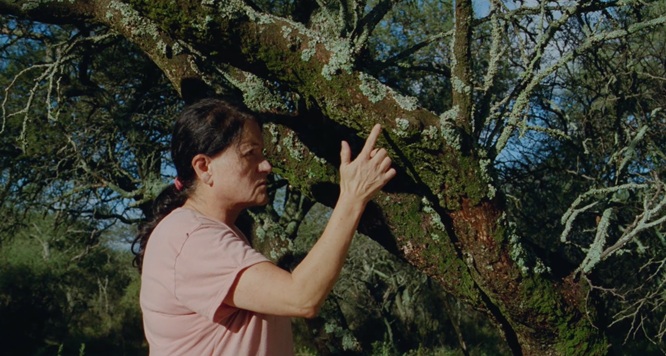
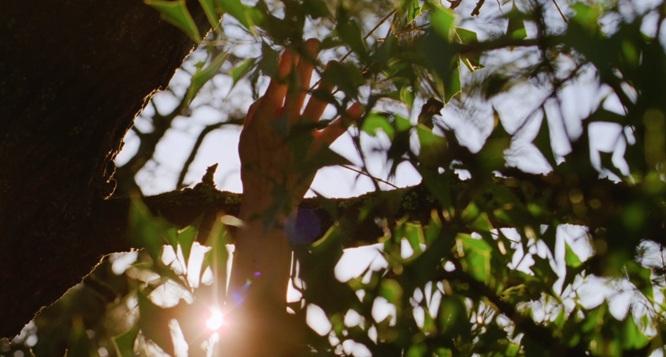
Language is perfunctory, strictly functional. Greetings and farewells. “The meat looks good.” Communication is not primarily language-based here. The interface, the medium of transmission, is the body and the world. In the morning, Micaela wanders away, her brother sets out to look for her and then returns without a clue. What do we know of each other after all? Is she different from a tree, a lark, a piece of grass? The deep state of being.
The film’s title promises that not one, but two will find freedom. Walk away from the drugs of pharmaceutical medicine, the drugs of machines that keep us from the world and the mysteries that lie outside language.
Thích Nhất Hạnhexplains:
“The forest was so immense we felt minuscule. I think we shouted to overcome our feeling of being utterly insignificant. It was also our way of compensating for the many social conventions forced upon us in the past. In the conventional world, we had to speak with restraint, guarding each word. Society dictates how we must eat, greet each other, walk, sit, and dress. When we came to Phương Bối, we wanted to cast off all of these rules and conventions. We ran and yelled to shatter social restraints and prove to ourselves that we were free.”
At the end of the closing titles, a strange intervention. We see Misael, but as a much younger man. He is laughing compulsively, nervously. It turns out this is his first camera test, shot before 2001’s Freedom. Unused to the camera and these unusual strangers, Misael can’t stop breaking up. Alonso wanted to use this shot in his first feature, but allowed himself to be talked out of it. Now, at last, it finds its place. At the end of another beginning.
[1] The quotations in this article are all from: Thích Nhất Hạnh. Fragrant Palm Leaves. Journals 1962–1966, Berkeley (CA), Parallax Press, 1966, p. 33.
All the images, © Planta / Deptford Film / 4L
*
Mike Hoolboom began making movies in 1980. Making as practice, a daily application. Ongoing remixology. Since 2000 there has been a steady drip of found footage bio docs. The animating question of community: how can I help you? Interviews with media artists for 3 decades. Monographs and books, written, edited, co-edited. Local ecologies. Volunteerism. Opening the door.
 |
envoyer par courriel | 
| imprimer | Tweet |





Site créé sur mesure pour Panorama-Cinéma par  .
.