
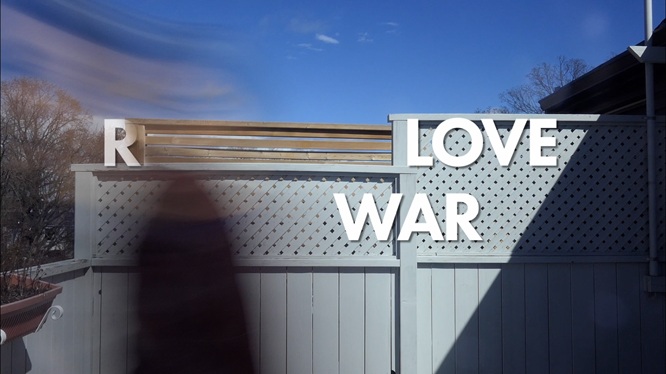
I think that, without Keith Lock, it’s hard to imagine that many in this country would be making movies at all. It’s not just because he’s the first Chinese-Canadian filmmaker in the country, but he showed me that you could be a filmmaker and still be a very sweet and shy, soft-spoken guy melting into the background. Keith was an invitation, a door opening in a city that was built without doors.
His new movie Relics of Love and War (45 minutes) is a family thriller that was kept under wraps for decades, until the Official Secrets Act allowed these stories to be told. Using a suite of stunning 35 mm photographs, Lock’s understated voice-over brings to life intimate details of his father’s World War II secret agent missions in Operation Oblivion, along with the anti-Chinese racism that was behind the passage of more than a hundred laws that expelled Chinese workers, stopped families from reuniting, restricted access to education and employment. Here, the smallest gestures carry a nationwide significance.
On January 13, 2024, Keith screened the movie at ConverSalon, a living room collective in Toronto that has hosted artists from around the world. Each evening begins with a free vegan dinner where people can explore unexpected encounters before the artist presents their work, everyone sitting on the floor or perched on a nearby chair. Here are highlights from the long post-screening chitchat.
*
Annette Mangaard: How long did you take to make the film?
Keith Lock: It took two years to make, but I’ve been thinking about it for a long time. I pitched it to the CBC [the national broadcaster] in the 1980s and the producer asked, “What percentage of the Canadian population is Chinese-Canadian?” I had no idea, but suggested 5%. He said, “Well, we can’t make a film for 5% of the population.”
Mike Hoolboom: Does it seem unusual that your father kept his WW2 suicide mission secret for nearly his whole life?
Keith Lock: We thought he was in the Dental Corps. The Official Secrets Act required that secrets be kept for 50 years—but there were hints. My brother and I had a BB gun. We set up HO gauge toy soldiers and held target practice. One day, my dad came downstairs and asked, “What are you doing? You don’t hold it up to your eye, you hold it down at your hip.” He took the gun and picked off every one of the soldiers and then went back upstairs.
My dad had a rule: never pay for parking. One day we went to the planetarium. We kept circling the block looking for a space. My sister and I were getting so annoyed, we screamed, “Dad, just pay for parking.” Finally, he pulled into the planetarium parking lot. The guard came over and said, “I’m sorry, sir, this is for employees only.” My dad looked at him and said, “Oh, that’s OK, I’m just going in to fix the projector.” [Laughs] Talking their way past security had been part of his military intelligence training.
In the 1980s, Roy McLaren, a member of Parliament, wrote a book about Canadians who served in Europe as part of SOE [the Special Operations Executive], the same intelligence organization that Ian Fleming, the author of the James Bond novels, was part of. When Roy found out that a small group of Chinese-Canadians was part of an SOE special mission, he talked to my dad, who had also taken a lot of photos. Before the war, Dad had bought an enlarger, and my grandmother really scolded him; she thought it was a complete waste of money, so he never used it. When I was seven, he set up the enlarger in the basement of his drugstore and showed me how to print photographs.
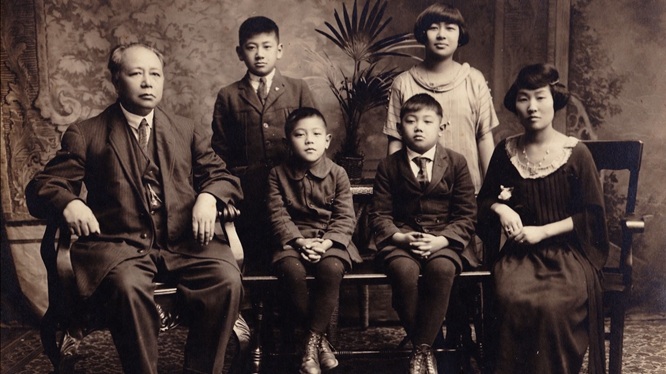
:: Keith's grandparents and their four children
Mike Hoolboom : Chinese-Canadians weren’t allowed into the university?
Keith Lock : They might be allowed in, but they couldn’t work. I did some documentaries for the Law Society of Upper Canada on the first Chinese-Canadian lawyers. Even if they graduated from law school, almost no one would hire them. Some went to a Jewish law firm, where they could apprentice. That’s what my father did: he apprenticed with Jewish drugstore owners, the Shapiros.
In those days, it was illegal in Ontario, Saskatchewan and British Columbia for a Chinese business to hire white women. I worked with Indigenous artists on Café Daughter [Shelley Niro, 2024], a dramatic feature that’s about a half-Chinese, half-Cree woman, Lillian Dyck, who became one of Canada’s top scientists and then a senator who advocated for Aboriginal rights. There’s a demographic of Indigenous and Chinese people, “Chindians,” who can pass in both communities. Lillian’s mother worked in a Chinese restaurant and eventually married the owner. Chinese-Canadian men grew up with very few women in that time. There was a saying: “The man is the head of the family in the household, the mother is the neck that controls the head.” [Everyone laughs]
Chris Kennedy : In the film, we look at 13 participants in a war. It was “the good war,” they were on “the right side,” but it was still a colonial project. There’s an element of national alignment; proving yourself as a Canadian is manifested in how one serves the war.
Keith Lock : They all believed in the highest ideals of the country, that it would come around and embrace fairness, and that they could make things better.
Chris Kennedy : As viewers, we want to believe in that country as well. You note that 600 Chinese-Canadian infantrymen served as well.
Keith Lock : The group of 13 special agents that included my father was the first Chinese-Canadian soldiers. When the army realized these guys could be trained, 600 Chinese men from the reserves were called up. Most Japanese men were in internment camps; they didn’t have an opportunity to do anything like this. But the Chinese… There were arguments, a lot of people in the Chinese community said, “No, we’re not going to serve. The country is not fair to us, so we won’t risk our lives.” One of the guys in the group, Eddie Chow, told me he joined the Medical Corps because he didn’t want to carry a weapon for those people [Canadians].
Serving in the war helped Chinese-Canadians gain the right to vote. Gradually, restrictions on employment were lifted. Having said that, Indigenous people served in the War of 1812—we’d all be speaking American if not for their service. But they didn’t get the right to vote until 1960. There’s no fairness in it.
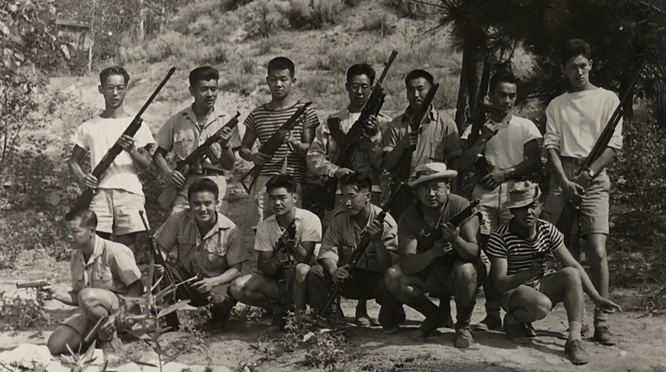
:: The group of 13 Chinese-Canadian special agents from Operation Oblivion, which Keith's father was a part of
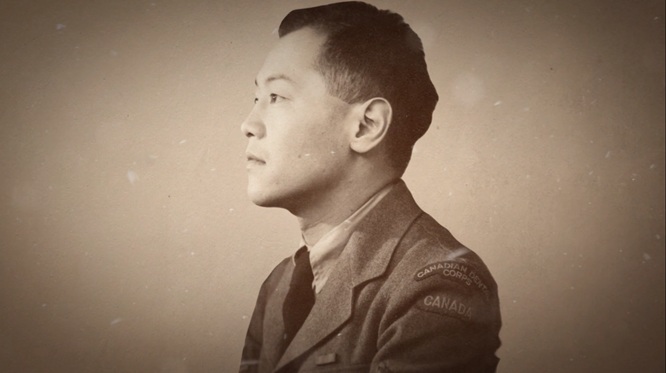
:: Keith's father, G. Tom Lock wearing the Canadian Army uniform
Kerri Sakamoto : In my Japanese-Canadian community, there are still questions about masculinity. There’s machismo in going off to fight, a fierce pride, some became community leaders after WW2, like Roger Cheng [among the Chinese-Canadians] who gained the confidence to become a leading figure. But Japanese-Canadian men also presented a different kind of masculinity, putting themselves forward in a more modest way, with some humility. This is all related to fighting for the country.
Ali Kazimi : I shot Forgotten Warriors for Loretta Todd in 1991; it’s about Indigenous war veterans in Canada. Their intent was to fight not only to prove their worth, but also to protect their treatiesand assert their rights. It was from the veterans that the Assembly of First Nations, which was initially called The Indian Brotherhood, emerged. When they came back from the War, they were treated differently. In fact, as you note in the film about Chinese-Canadian vets, they were not accepted into the Legion.
Keith Lock : My father hated two things: policemen and the Legion. He told us that, when he was eleven, there was a problem with my grandmother’s hand laundry, and he was told to get a policeman. When my father approached, he was told, “Police services don’t cover Chinese.”
Whenever we walked by the Legion Hall, he would say, “They just sit in there and drink all day.” Later, I learned that they didn’t want Chinese veterans, so they had to start their own Legion in Vancouver.
Jorge Lozano : Chinese-Canadians are still being discriminated against today, as we saw at the beginning of the COVID-19 pandemic. What drives people to want to be equal to those who don’t recognize them?
Keith Lock : There’s Confucius and Christianity. Confucius is deeply embedded in Chinese culture. It posits a moral right that transcends identity. Many Chinese became Christians because they were treated fairly by the Church and the YMCA. But there was no fairness at the higher levels, in government or employment opportunities.
In the early 1980s, I did a documentary for CBC Toronto on Chinatown, and that’s when I found out Chinese-Canadians couldn’t vote [for some time]. I thought everyone could vote in Canada, but when I asked my dad, he said if he tried, they’d kick his butt and throw him out.
There was a big civilian effort to gain the right to vote, to get fairer laws that didn’t discriminate against Chinese-Canadians. The veterans contributed to the process of getting the vote, but it wasn’t just them; there was a massive community effort.
My grandmother worked really hard in the laundry, supporting her kids. Most people were just concerned with staying alive! It was very difficult. Chinese-Canadians could only work in a laundry, a grocery store or a restaurant. And no one ate Chinese food back then!
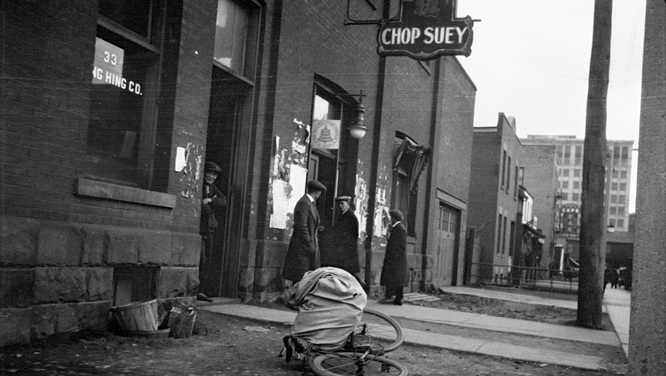
:: On July 1, 1923, long referred to as 'Humiliation Day' by the Chinese-Canadian community, Canada passed the Chinese Immigration Act, or Chinese Exclusion Act, which banned almost all Chinese immigrants from entering the country
b.h, Yael : They were Canadian citizens, but couldn’t vote?
Ali Kazimi : You were a resident of Canada, but without the franchise. Also, if your name didn’t appear on voting lists, there were many professions you couldn’t enter.
Keith Lock : They didn’t have passports, but little cards that identified them as residents of Canada. I found a document of my dad’s signed by one of the Chinese embassy staff. He also had an identity card, mostly to prove he wasn’t Japanese-Canadian. It was a second ID, after the one that identified him when they started the Chinese Exclusion Act [Chinese Immigration Act]. They had to carry both cards at all times.
In 1923, Canada passed the Chinese Exclusion Act, which banned the Chinese from entering Canada for 24 years. At the same time, the government photographed every Chinese-Canadian in the country. They were meticulous. My father has a card with his picture on it, taken when he was seven or eight.
Jorge Lozano : Did the Exclusion Act only ban the Chinese?
Ali Kazimi : South Asians were also excluded, but again, geopolitics enters the picture as it does today. Look at Ukraine and Palestine. Since China was a weak state at the time, both Canada and the United States could legislate Chinese Exclusion Acts without consequences. With India, it was different. There were going to be repercussions because of the Indian independence movement, so the British were very careful. Canada did not control its own external affairs until after World War I. British instructions were clear—you can exclude Indians, but you cannot name a policy using race or nationality. Instead, [the Canadian government] devised the Continuous Journey Regulation barring anyone who, “in the opinion of the Minister of the Interior… did not come from the country of their birth or citizenship by a continuous journey.” As international travel was restricted to boats, this made South Asian immigration impossible. The results were even more severe than with the Exclusion Act.
Keith Lock : My great-grandfather came to Tasmania [an Australian province] in the 1860s and then went back to China, where he married my great-grandmother and brought her back to Australia. When she arrived, she cried for three weeks without stopping. She had bound feet, and my great-grandfather had to build a fence around the house because locals were peering in the kitchen windows at her. The house became a historic site; it was recently burned down by arsonists. There’s also a tourist cabin named after my great-grandfather in Tasmania. I went there in 2018 with my family, and when people learned we were relatives of this Ah Moy guy, there was a big reaction, from the checkout clerk in the supermarket to the museum curator, who showed us part of their collection related to that time. They’re trying to make that Chinese-Australian history visible again. But perhaps the real reason is that they get a lot of tourists from China. [Everyone laughs]
Ali Kazimi : When Australia became a commonwealth in 1901 and proclaimed the White Australia policy [Ed. note: The Immigration Restriction Act 1901, one of the White Australia policy], it had huge consequences in India. Given the significant Indian population in Vancouver at that time, Canada was determined to do the same. It’s interesting that your Chinese-Australian mother, whom your father met and married during the War, needed special political dispensation to be able to accompany him to Canada.
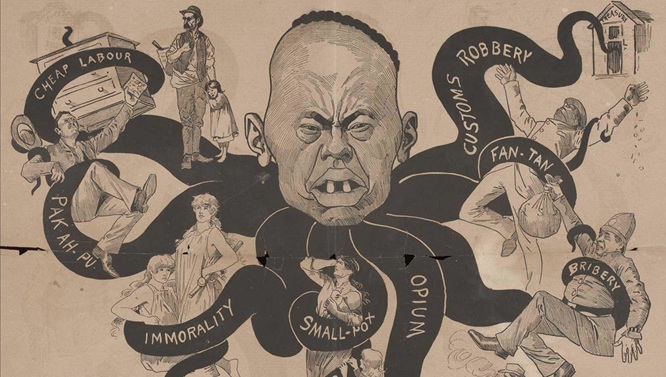
:: Propaganda poster during the White Australia policy
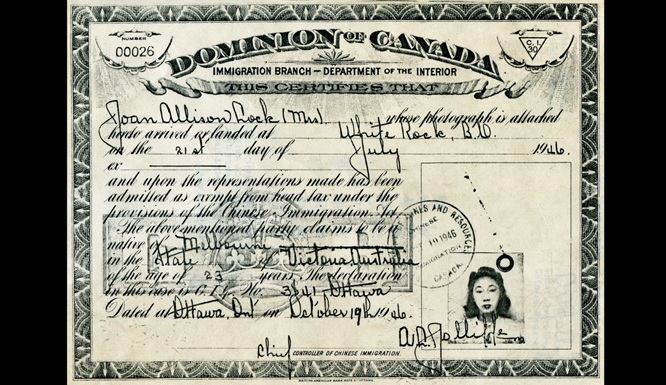
:: The immigration certificate granted to Keith's mother to immigrate from Australia to Canada, signed by the Chief Controller of Chinese Immigration
Keith Lock : It was an act of the Privy Council. It might be because some of the white soldiers stationed in Hong Kong married Chinese citizens, though that’s pure speculation.
Chris Kennedy : When your father and his intelligence group were stationed in Australia for further training, they met many Chinese-Australian women. Why were there more available women in Australia?
Keith Lock : Because patterns of immigration were different. In Canada, Chinese-Canadian men came to build the railroads. They wanted to bring women, but that was stopped after the railroad was finished. For my generation, the railroad was almost sacred because so many died building it. It was the one thing the community could say, “We built that, it’s a contribution.” Even though it was on Indigenous land… Our elders tell stories about the kindness of Indigenous people. If a worker was injured, the employer would leave them to die. But if an Indigenous person found them, they would be treated and healed with medicine. The community has always been grateful for that. So when Mohawks blockaded the railroad at Kanesatake in 2020, the Chinese Canadian National Council put out a statement saying that we stand with the Mohawk Nation because they helped us. I was on a film shoot with Indigenous artists and told them this, and they laughed in delight because they’re always presented in stories as barbarians, but here they were portrayed as healers.
Ali Kazimi : There was a lot of Chinese immigration to various states in Australia before it became part of the Commonwealth. The idea of the head tax, of applying a tax to a particular nationality (in this case the Chinese), was an Australian invention that began in the state of Victoria. It was then adopted in California before becoming Canadian policy. As the first Prime Minister John A. Macdonald said, “We don’t want Canada to become a mongrel race.” Miscegenation and white supremacy were deeply embedded in Canada’sImmigration Act. The idea was to dissuade and discourage Chinese workers from staying after the railroad was built. Very few women were allowed in, the ratio was about 36 men to 1 woman. That applied to South Asians as well.
There was a different dynamic with the Japanese because of geopolitics. Japan was a rising imperial power; it had signed treaties with the British. Japanese ships actually patrolled the West Coast of Canada in the early 20th century, and were welcomed and celebrated when they came into Vancouver. There was a secret 1908 agreement, The Gentlemen’s Agreement, a handshake deal that admitted 400 Japanese families into Canada each year. By contrast, the Chinese and South Asians were bachelor societies.
Kerri Sakamoto : There was an intelligence unit of Japanese-Canadians who served in Europe. At the same time, Japan was an enemy during the [Second World] War, and Canadian-Japanese were put into internment camps following the American example. Yet, some American-Japanese soldiers were involved in the liberation of the concentration camps [in Europe]. Your film talks about duty [for the Chinese-Canadian members of the SOE], including the duty to remain silent, their loyalty to Canada, wanting to prove that they were worthy of citizenship. It’s so powerful.
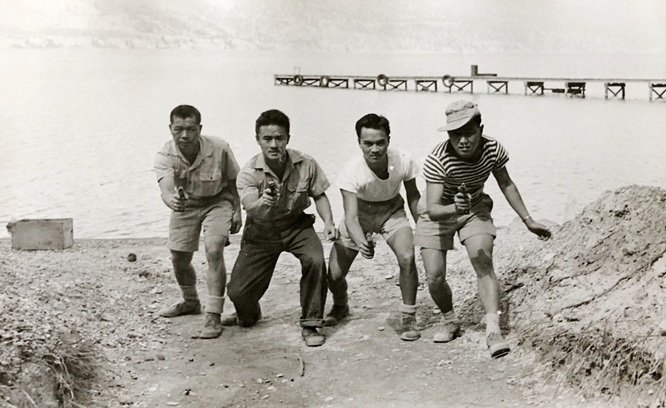
:: At Commando Bay, the secret training camp of the thirteen Chinese-Canadian soldiers
Keith Lock : In Toronto’s old Chinatown, at Bay and Dundas, the centre of the gay scene was the Continental Hotel and, one block away, the lesbian scene gathered in the Ford Hotel. My dad’s pharmacy stood between the two. Because of all the bachelors, there was a lot of “Che Guy Nui” or “Car Street Women.” I never saw a Chinese woman do that [sex work] because there were so few. The Kwong Tung Hotel across from my dad’s pharmacy rented rooms by the half hour.
One of the Che Guy Nui was Irish and had a two-year-old daughter who was half-Chinese. When she was working with a client, she would leave this kid on the street, and my grandmother would take her in and look after her. Eventually, she adopted her and she became my cousin. She married a Chinese student from China in the 1950s and went back with him to China. She became the English language news voice of Radio Beijing. She had a very deep voice and received many marriage proposals. One day, the Royal Canadian Mounted Police (RCMP) came into my dad’s store. They wanted to know about his connection with my cousin, but because of his intelligence background, they backed off.
b.h. Yael : You said you spoke to your father, did you record that? And, if so, why didn’t you use any of his voice?
Keith Lock : I made recordings with some of the veterans and shot an interview with Hank Wong before he passed away. But I didn’t use those. I didn’t think I could make it fit. Using only my voice created a more consistent style. Mike [Hoolboom] and Midi Onodera convinced me I could do it this way. I didn’t think you could just talk over a film. [Everyone laughs]
Ali Kazimi : I’m interested in the use of music and the creative choices you made.
Keith Lock : I didn’t want music to tell the audience what to feel. I wanted the audience to think about what they were seeing and come to their own conclusions.
In my research, I found reports on each of the men who were sent to SOE [the intelligence headquarters] in London. It was like reading my dad’s report card. It noted he was smart and that his Chinese was good. But also that he didn’t really like killing with his bare hands. That was part of their standard training.
Kerri Sakamoto : The forensic formal strategy works beautifully and poetically with recovering memory and traces. And your bracing humour! When you look at a strange framing and discover a woman hidden in the corner of the photograph! Finding bullet cases your father might have shot decades earlier, the painted figures on the rocks—it was all beautifully integrated.
Keith Lock : There’s a plaque that commemorates the 13 Chinese soldiers of Operation Oblivion at Commando Bay [south of Kelowna, BC], where they trained. The plaque was put up in 1988; 50 years had passed, so it was legal to acknowledge. I went back to shoot there, but during the scene where they’re talking about the plaque, I didn’t know the camera was running. That’s why the framing is strange. Something made that shot so I would have a record.
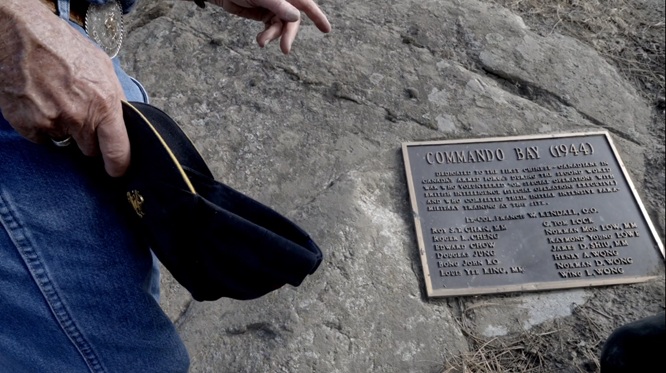
:: The commemorative plaque honoring the 13 soldiers of Operation Oblivion
Stills from Relics of War and Love, © Keith Lock, 2023
 |
envoyer par courriel | 
| imprimer | Tweet |





Site créé sur mesure pour Panorama-Cinéma par  .
.