
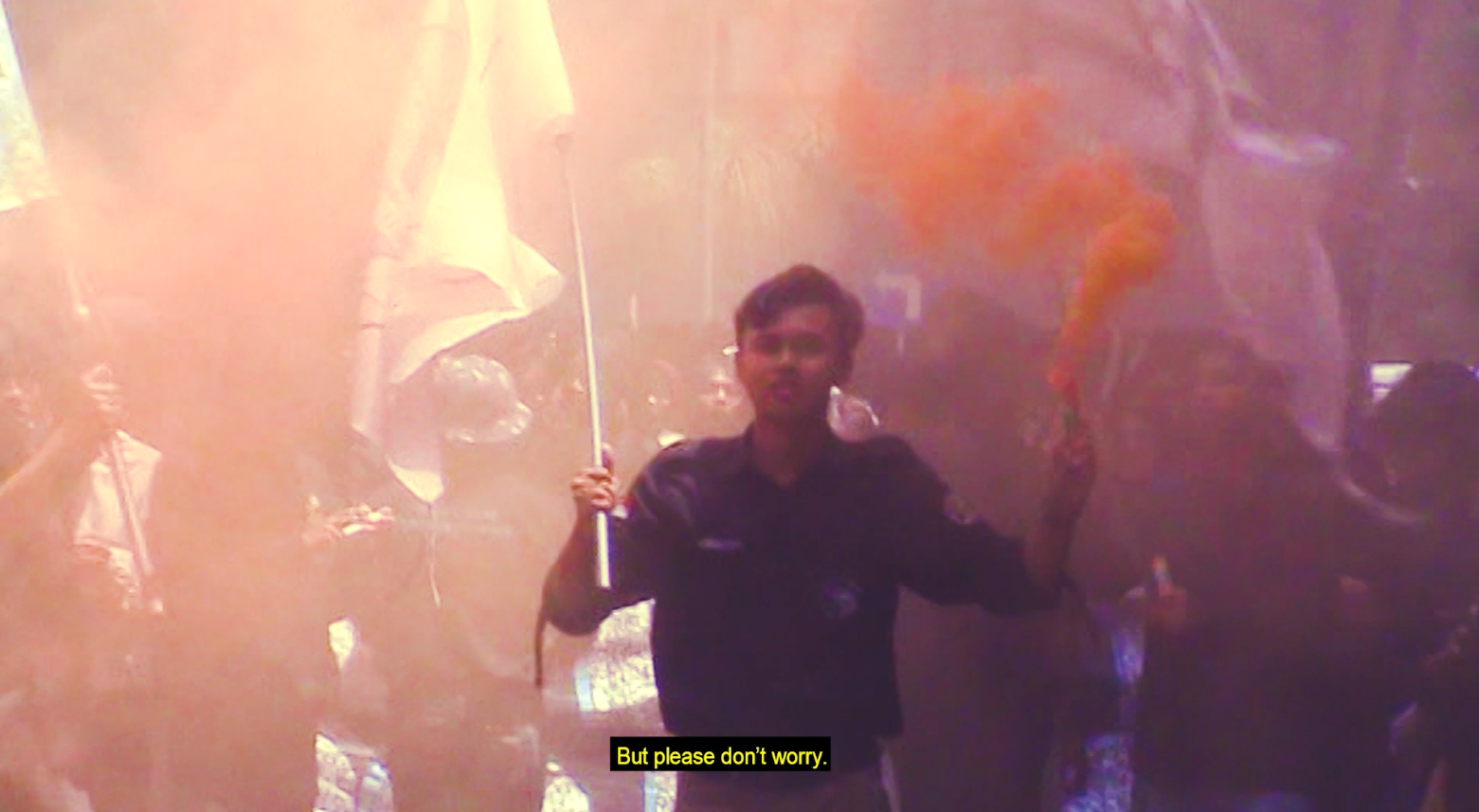
Letters. The originary point of the essay-film might be found in the letters of Sandor Krasna to the female narrator in Chris Marker’s Sans soleil (1983). Their correspondence creates a flexible spine that permits forays into Japan, Guinea-Bissau, Iceland and beyond. Marker showed us that letters can stitch together distant geographies. What Indonesian filmmaker Beny Kristia demonstrates, in his brilliant short When the Blues Go Marching In (Pengais Mimpi, 2025) is that letters can also bring together different times.
Letters from the artist to his father fill the soundtrack. The artist/activist has left home, he apologizes for not responding sooner and recounts dreams borne of exhaustion. In his dream, a poem leaves a mark on its reader, as if the dreamer were a book read by language. A citizen read by the state. The tone shifts to anger as he accuses his father of failing to bring about the necessary political changes. “What kind of world have you left me, Dad?” The revolution may be televised, but it is never finished.
The artist begins with a difficult question: how to make pictures of a social movement? The space of this picture is already framed by corporate media. If anyone, but the government—no matter how violent or corrupt its leaders—weighs in on political questions, they are dismissed as dangerous mobs. How to create a counter-picture that will grant centre stage not to the one, but the many? How to counter the dangerous shorthand of the superman with the necessity of collective effort?
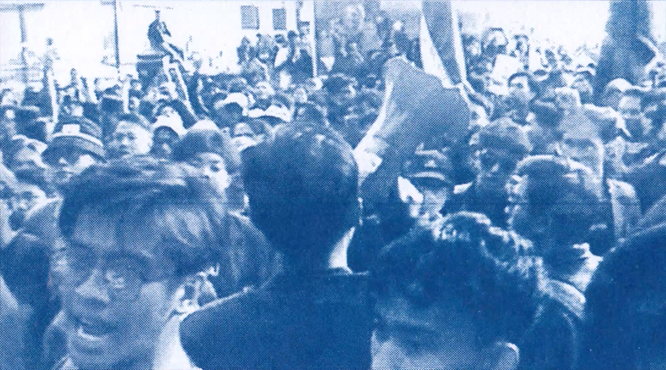
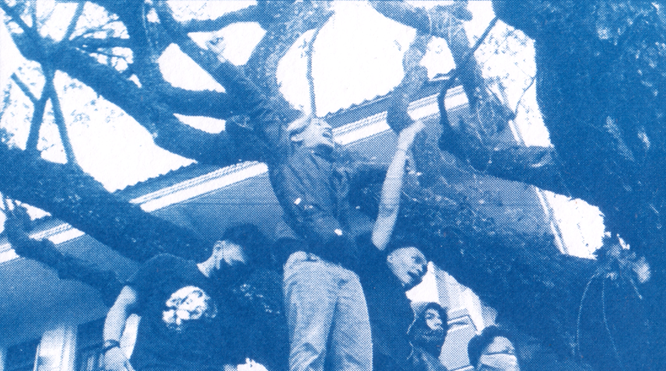
Blue-tinted cyanotypes show student protesters from Universitas Brawijaya in Malang in 2024. And little wonder. Most formerly colonized countries carry the unwanted inheritance of ruling class families that regard the state as a private resource that can be plundered for personal gain. Laws were changed not once, but twice to allow departing president Prabowo Subianto’s sons to run for elections. The old formula: collectivize risk, privatize profit.
Before taking to the streets, protesters began with a meme campaign showing a fictional Emergency Alert System warning rendered with the national emblem (a bird that appears on the Indonesian flag known as the Garuda Pancasila) against a deep blue background. It became known as the blue Garuda. On the streets, marchers decried government corruption and, while these images were made by the artist, they appear vintage, faded, they have been treated to appear old, as if the cycles of protest were recalling and repeating themselves. Taking a cue from the blue Garuda meme, they appear in a deeply blue cast.
The artist was part of the demonstrations. In medias res. But the political diary recordings were not enough to complete the act of witnessing. The footage needed to be retouched and remade by hand. Rescued from a vanishing digital world and turned into objects that could be held, scarred, cherished.
“First, we broke down the footage (digitally) into 24 frames per second. Then, we arranged it on paper in a 3 × 3 grid, nine frames on one sheet of paper. We printed these negatives on mica paper. This mica paper became new negatives. It was placed on top of A3-sized black carbon paper that had been coated with a chemical solution and left to dry in the sun for several minutes. The black carbon paper was then washed with water and dried indoors. This was done in my boarding house room. Once dry, it was scanned and edited. The nine blue-printed grids were cut into frames.” [1]
Dad, what I saw felt oddly familiar. [2]
Protest signs carried by activists are cleverly matted out and replaced by images of historical marches in Indonesia. What they are carrying is an image that belongs to their parents, an intergenerational solidarity that is also a mise en abyme. The cries of “Long live students!” feel at once inspired and defeated because the students are still shouting, on the same streets, for a justice the law fails to deliver, for a politics abandoned by politicians.
A counter-movement collects on the streets by men as young as the protesters. The police arrive. Is it a surprise that so many young people in uniform, often (though not always) economically disadvantaged, heed the call from countries around the world to beat their neighbours into submission and torture prisoners? The violence of the police is an ordinary violence. Catastrophic, life-changing or life-ending, meted out with impunity, these actions are carried out by sons and neighbours and brothers. Ordinary boys, good boys.
I hope people won’t stop chanting, burning, destroying.
A long night scene in black and white follows. The man writing to his father appears declaiming his letter in an angry and anguished howl. How can we make the new world when we are condemned to using the methods of the old world?
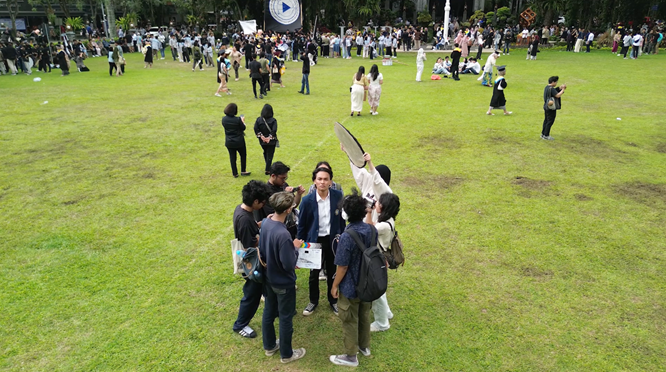
The scene shifts. The speaker stands in the middle of the frame, now surrounded by a recording crew on the grounds of a university. As his speech ends, the crew leaves and the screen breaks up into separate frames showing graduation ceremony glimpses. These gestures of exultation are also familiar and reliable: the public displays of emotion, the relief of proud families. Each year the same routine, and yet always new. That they are played out on the fields of an educational institution asks: what have we learned here? What is education if not a place where histories are studied and consecrated, sometimes even replayed?
As the band Sukatani’s underground viral anthem “Dark Excitement” (“Gelap Gempita”) rages on the soundtrack over the closing credits, demo images are repeated, but now in hand-processed black and white. Touched by hand, the images are worn and crumbling. Yes, the techniques may be old, but they are made new again by the determined hopes of a new generation. After all, Indonesia is a country where social movements have toppled dictators in two distinct periods.
How is Mother?
The band’s vocalist Twister Angel said the song was a response to the mass demonstrations of the past couple of years, when thousands of students took to the streets protesting criminals in government and the brutal police force that protected them. This film is an act of solidarity with those on the streets. A counter media, a counter image, a counter society. As Twister Angel sings: “The light shining on them will be blocked by this flag.” [3]
[1] Rahmania Nerva. “Siasat Pengais Mimpi Mematerialkan Memorinya: Wawancara dengan Beny Kristia.” Minikino, Oct. 22, 2025, minikino.org
[2] All italics are excerpts from When the Blues Go Marching In, by Beny Kristia.
[3] www.paroles-musique.com/eng/lyrics-Sukatani-Gelap-Gempita-en-translation,t1768816
All images courtesy of Berakinema.
:: When the Blues Go Marching In (Beny Kristia, 2025) [Berakinema]
*
Mike Hoolboom began making movies in 1980. Making as practice, a daily application. Ongoing remixology. Since 2000 there has been a steady drip of found footage bio docs. The animating question of community: how can I help you? Interviews with media artists for 3 decades. Monographs and books, written, edited, co-edited. Local ecologies. Volunteerism. Opening the door.
 |
envoyer par courriel | 
| imprimer | Tweet |





Site créé sur mesure pour Panorama-Cinéma par  .
.