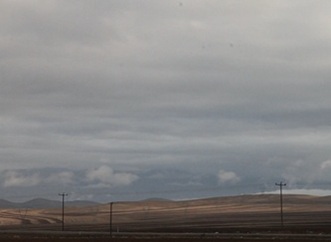
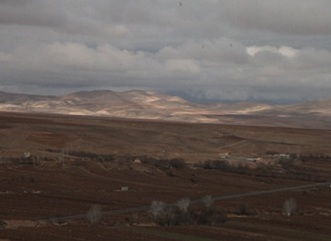
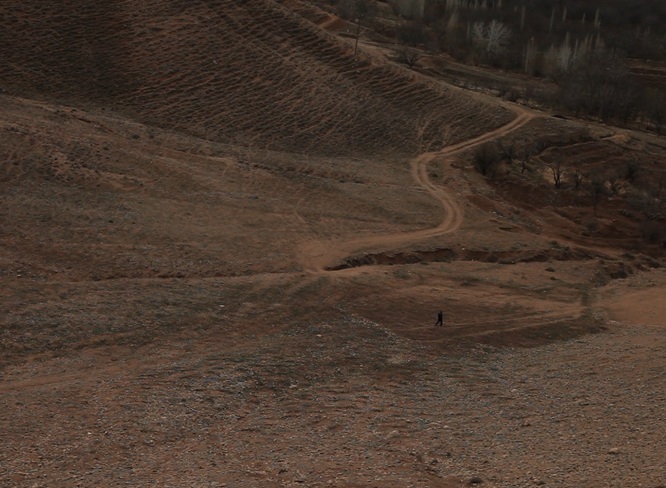
Parastoo Anoushahpour’s patient ethno-documentary Peacocks Come with the Clouds (2026) opens with three long shots of the land, stripped and bare, worn out by human extraction. The villagers who are left here in the unwanted borderlands between Iran and Turkmenistan are rich in lore, reframed by a culture of a poetry and weaving, and poor by every other measure.
Mother is a word that is sleeping in the next room. [1]
The camera moves in soft tentative pans or not at all, content to wait patiently while fingers touch every word on a page of poetry, or children dress up for unseen rituals. Later, they appear posed and seated, describing the embroideries they’ve just seen. Each account is different, history lands in every body in its own way, according to its own mysterious needs. I’m trying to imagine a cultural moment here, in the north, where the Internet fills every face to overflowing morning and night, where children, or anyone at all, might take the time to describe their reaction shots to a cultural moment.
The distances that have grown closer.
Children live at the heart of this film. They are past and future. Reinventors of culture. They huddle close to listen to one of their comrades whisper a story that delights. They rehearse a play, even while some amongst them are living inside another play. They are not spectators of someone else’s culture, they are culture. This culture lives in the bodies they make and unmake together. The teacher is a facilitator, she is there to listen and respond and gently guide. A river without banks becomes an ocean. When a girl starts dancing, the teacher’s job is to shift the room’s attention so that everyone can notice what is happening in the present, the place where history flickers back to life again. Knowledge is another form of play. Seeing and listening are actions of the whole body at once. The body is the teacher and they are teaching each other.
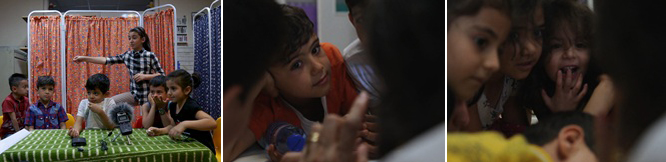
The words that will remain from us will experience a strange insomnia.
Is this what democracy looks like? How would I know? I’ve never lived in one. I live in a country that claps its hands when our leaders let the words of the largest corporations come out of their mouths.
The image that wants to keep me alive is now small, small.
The chicken factory is a merciless assembly line of death. Is it a quibble to ask the artist not to film it so beautifully? The worker shadows gather and then engage, parts of the same machine, the killing floor that makes life possible.
Poetry is the touchstone here. The deep touch of the Kurdish language, the centuries of living as outcasts, the expressions of the dispossessed. Such a clear frame from which to understand self and world. The worst insults are reserved for the enemy: that they are illiterate. But even as these deeply lived aphorisms appear, there is always a steady din of children chattering in the background, of doors opening that we never see, footsteps wandering that we never follow, and the most perfect sound of the plains: gravel crunching beneath slow moving tires. They are a reminder that life is happening outside the frame, and that, even inside the frame, there are mysteries that can only be suggested. Like the short film wonders of Payal Kapadia, wonder and the everyday are mixed, and woven through both is the sense of the ongoing struggle to eat, to be a mother, to carry the hopes of a village.
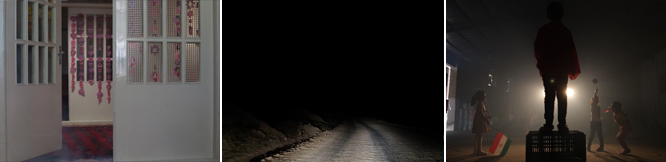
In the movie’s closing shot, a wide landscape reappears, stripped and barren, the slim forest trees burning. It looks like a painting. The shot lasts a long time, though not quite as long as a life. Deep into this shot, the frame freezes for a spell, and then begins again. I think the artist suggests: this is what I managed to bring to you, this moment from the fire, that’s all. A slice. An impression. Something radically incomplete. Can you live with it, can you let it touch your own incompleteness?
The screener I’m watching the movie on says “V6”: version six. I imagine the years floating past in a haze of editing. Searching for the right balance. Holding a place for the invisible world. The unspoken that lies at the heart of all this speaking. Each version is hope and fantasy. And then at last: here it is, a private mulling is ready to step into someone else’s unknowing. But the fantasy breaks, another version is required. Again and again. The conversations that force the artist to turn back to the bottom of the mountain where the task is still waiting. How long will this infinity last? How many beginnings are required? Six it turns out. Let’s just call it: the most mysterious, the most perfect documentary of the year.
[1] All quotations in italics are from the film.
All the images, © Parastoo Anoushahpour
*
Mike Hoolboom began making movies in 1980. Making as practice, a daily application. Ongoing remixology. Since 2000 there has been a steady drip of found footage bio docs. The animating question of community: how can I help you? Interviews with media artists for 3 decades. Monographs and books, written, edited, co-edited. Local ecologies. Volunteerism. Opening the door.
 |
envoyer par courriel | 
| imprimer | Tweet |



Site créé sur mesure pour Panorama-Cinéma par  .
.