The oldest questions are the hardest to answer. Perhaps that is their gift, their charm and ongoing allure. What are movies for? What do they do, and how do they do it?
Unable to travel, I imagine myself in a new country, and in this place, there is not a single picture, not a magazine, a soap opera or even an advertisement that shows someone like “me.” The colour of my skin, my sexual preferences, my upbringing, none of this is on display. In place of a hall of mirrors, there is a hall of blanks. When I try to touch my identity markers, or imagine what desire is like, or friendship, or what it means to be a son or a mother, there is only a deadpan silence. In this country I do not yet have a face.
Slowly I begin to work on a movie. Let’s call it: the road not taken. Another opening move for cinema, another restart. It will show people like me how to fall in love, what family life might contain, even what is forbidden. But unlike genre flicks, it won’t offer a full narrative expression of these salient moments; instead, it will operate like a kind of directory, a mobile audio-visual library that can be summoned, referenced, quoted and repeated.
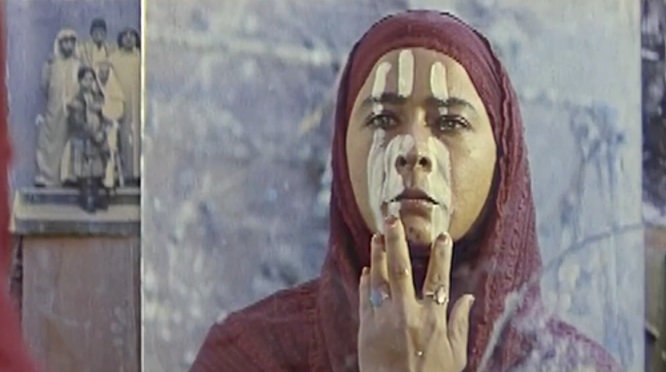
This is what I feel while watching Maryam Tafakory’s Nazarbazi (20 minutes 2021). It is a movie made out of other movies, small snippets of Iranian feature films carefully excised and collaged to produce a taxonomy, which freedictionary.com says is “an ordered arrangement of groups or categories.” The movie shows me how to hold a cup of coffee, how to walk across the floor to approach the one you’re not supposed to be in love with.
we
Scorched across these stolen pictures are brief text fragments that appear in Farsi and English. The first word is we. It announces a congregation, an intended audience, and let’s be clear, I am not part of that audience. The movies Tafakory cuts up like a surgeon are not part of my childhood, they didn’t see me across the threshold of adolescence. But for successive generations of Iranians after the 1979 revolution they did exactly that. Because the American cinema does not occupy every screen in every theatre (like they do here in Canada), there is room for local cinemas, and while most are domestic rebrands of popular forms, homegrown stars and settings have become a common place in Iran.
we were informed from the outset
Tafakory’s “we” is a reminder that cinema remains a collective project. With a word she summons not just a collection, an archive of shared pictures, but also their audience. In each frame, there is the palpable sense that the image is looking back at this audience, that viewer and viewed are touched in a mutual embrace.
of how this journey would conclude
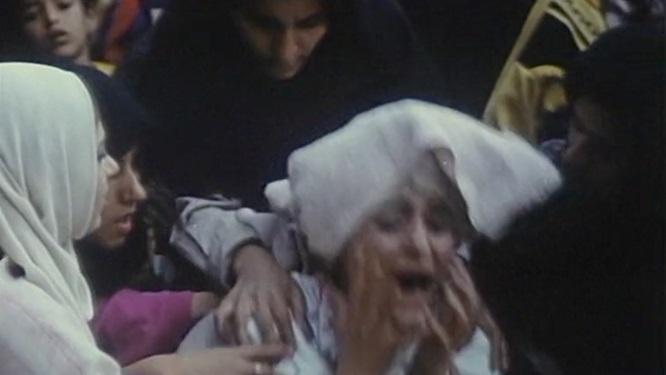
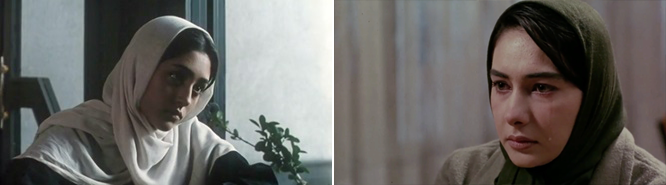
The title Nazarbazi means “a play of glances.” The artist summons a history of looking, showing how a body turns into an image under the withering gaze of the state. What is uncanny, what turns this story into a ghost story, is the way every image recalls its home and origin in a fiction film, while at the same time appearing like a snapshot of everyday life. It’s as if a well-attended play were missing a pair of its leads, and so members of the audience, who had attended the show many times, leapt in to take their place. In Nazarbazi the cinema wanders off screen and turns into everyday life because the look between movie and moviegoer, this play of glances, is already embedded in the image. The sense of being looked at, of a people condemned to watch over themselves, creates an audience who are already characters in a theatre without end. This play of glances is also framed by a cruel and omnipresent censorship, which shows itself by rendering the most essential parts of these haunted shadows invisible.
i travel outside my body
Every object is also a body. When I open this bag, I’m showing you liver and kidneys. This broken necklace is a heart. This face is a wall to paint graffiti on, because my reaction shot (my life is a reaction shot), my looks of warmth, shock or caution, are also graffiti. Strangers leave their mark on this wall of a face, especially the ruling council, the religious fathers who have turned their fear into codes of conduct.
and inside there are continents
that i do not know
The artist creates dense clusters of images, as if, like so much poetry, the impressions are not intended to be seen but to be re-seen. Pored over. Re-examined. It is enough, on a first viewing, to sprint alongside the poet, jamming connections, catching a glimpse, chasing those hands that reach for his hope, the fingered veil, the face that breaks open and then composes itself. A milk bottle smashes, before a hand reaches for a glass of milk. How many bottles need to be broken in order to create a glass of milk? How many lives need to be taken, in order for me to wake up each morning? How many hands have unmade this bed?
it is precisely here
that the disaster commences:
to enter into oneself
and wander
A woman pulls a lace curtain across a suite of windows overlooking the sea. A small title announces: I am naked. Because I am always wearing clothes, I am always naked. The words are by celebrated Iranian poet Forugh Farrokhzad, from her 1965 poem “Let Us Believe in the Beginning of the Cold Season.” She died in a car crash at the age of 32, but not before she had divorced the man she was told to marry, surrendered her child, and dedicated herself to her work as a poet. In a culture founded on the invisibility of women, how did she manage? Perhaps this is part of what gives her phrases such a ring, as if they were laid down in blood only this morning, every note a debt paid for a hundredfold.
The text extracts are from a variety of sources, including Roland Barthes’ a Lover’s Discourse: Fragments. This deeply personal notebook offers a collection of small wounds lit up by the delicate incandescence of his prose. “I have no skin (except for caresses),” he wrote, as if his body was not singular and autonomous, but came into being only in relation to another. Why else argue, as he did with typical persuasiveness, that the author was dead?
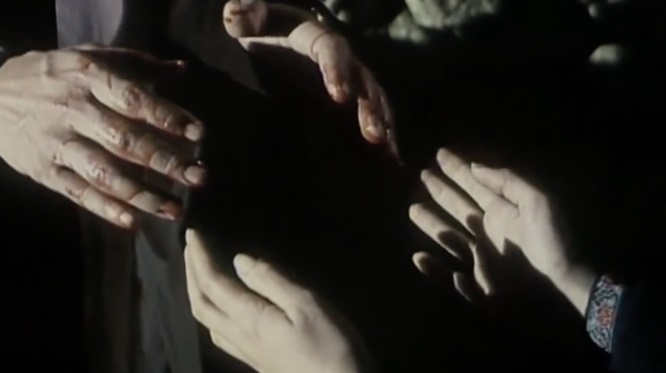
In a frank echo of her earlier short movie, Irani Bag (2020), Tafakory produces a long sequence of shots that show hands almost touching her face, his face, each other. Slowly, as if they lived in a time zone all their own, these hands make their approach, trembling at the threshold of a forbidden touch, because state censors have banned any physical contact between genders. The result is a series of skin prosthetics, a new fetish arena where handbags, notebooks, suitcases, even baskets of fruit can become objects that stand between and stand in for, the forbidden act of touching. When I spoke to my pal Taravat she offered that it was such a common practice in Iranian cinema that it passes largely unnoticed. These screen bodies never lose contact with the state, they are constrained and pressured, bent and turned, so they turn everyday objects into genitals, invent ways to give birth to their own urgencies and pleasures.
in order to show you
where your desire is
it is enough to forbid it to you
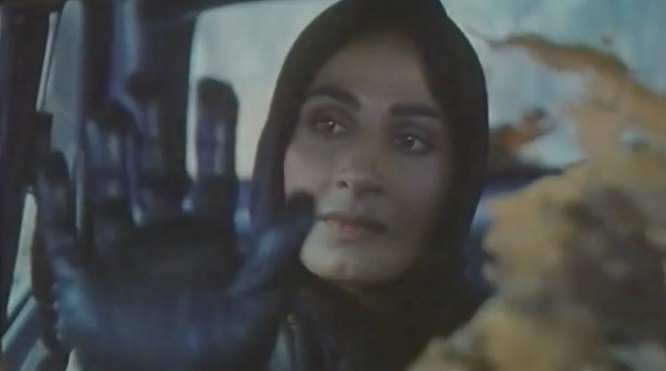
“When our eyes touch is it day or night?” Derrida’s famous opening line of his book On Touching muses on how it is impossible to touch someone, without being touched in return, just as day and night commingle. He calls an exchange of looks (or as the film’s title reminds us: an exchange of glances) “touching the eyes.” Nazarbazi also marks the uneasy intersection between looking and touching. Here is a haptic cinema of charged encounters, where household objects turn into bodies, and bodies turn into objects. Banished to a country without touch, even the air in these frames throbs with sensation, the wind and dust carry the charge of a caress, a cold shoulder, an open wound. And in the close-up spaces between bodies, an endless procession of eyes touch a stranger’s elbow, they caress a lover’s downcast face, drink in a radiant smile. I kissed what he kissed. That’s how he kisses me. I touched what she touched. That’s how she touches me. Everything vibrates with longing.
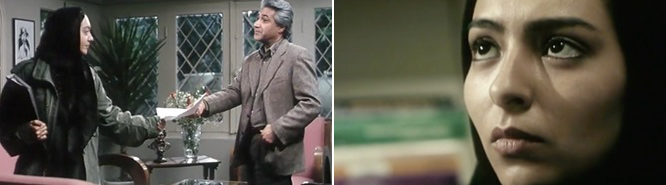
This morning the artist wrote me a long and unexpected mail. We have a mutual friend, Caspar, whose warmth is so shining and open-hearted, that it turns everyone in his network into a familiar.
“The last time I was arrested, I asked myself, ‘Was this film necessary?’ to which the answer in my head was always a ‘no.’ And of course, the more unknown you are, the more at risk you are. I guess with Nazarbazi, I tended more towards privileging ambiguity, but also using banned text/poetry in the film means I already undermined the task I set myself with. But again how many viewers outside Iran would know about the banned poetry in the film? Would I dare put it in the synopsis? No. I started my day this morning by sending a long email of corrections to a festival that took the liberty of writing their own synopses for my films, which were full of buzzwords that could get me into trouble back home. It's an endless headache that has no remedy, which also is a testament to the power of authoritarian regimes — it doesn't matter how far away you are, it follows you everywhere. There are many unspoken rules whose unveiling is a double-edged blade; you can no longer make films if you talk about them openly and you will be at risk of imprisonment. But staying silent doesn't protect us either.”
The artist is also a picture in this collection of pictures. She is the wind that blows through his hair. The scarf too freighted with grief to lift in the breeze. Her autopsy examines these bodies with care and anguish, one eye touching another, because they are also parts of her, the past that keeps turning into the present. Unwilling to hold herself at some lofty philosophical remove to pose the fundamental question of how pictures work, she offers up her own body, and the body of Iranian dramatic cinema, in a duet of seer and seen. It is a deep inquiry, filled with an energized attention, a restless flow, and more than that, the keen sense that there is something at stake in this making, in the Frankenstein act of putting this body of pictures together. As a protest against state censorship, and the hatred of women that wears the mask of piety, the artist finds a voice, even a body, through the act of poetry. The meticulous stitching on display is a necessary invention that does not spring her from the trap, but allows her to map the contours of the new bodies that the trap has made necessary. I can only watch in wonder as the artist/curator turns moments of nearly 90 movies into a science fiction of the present, offering evidence that the screen touches back.
All images and quotations in italics are from Nazarbazi by Maryam Tafakory.
*
Mike Hoolboom began making movies in 1980. Making as practice, a daily application. Ongoing remixology. Since 2000 there has been a steady drip of found footage bio docs. The animating question of community: how can I help you? Interviews with media artists for 3 decades. Monographs and books, written, edited, co-edited. Local ecologies. Volunteerism. Opening the door.
 |
envoyer par courriel | 
| imprimer | Tweet |



Site créé sur mesure pour Panorama-Cinéma par  .
.