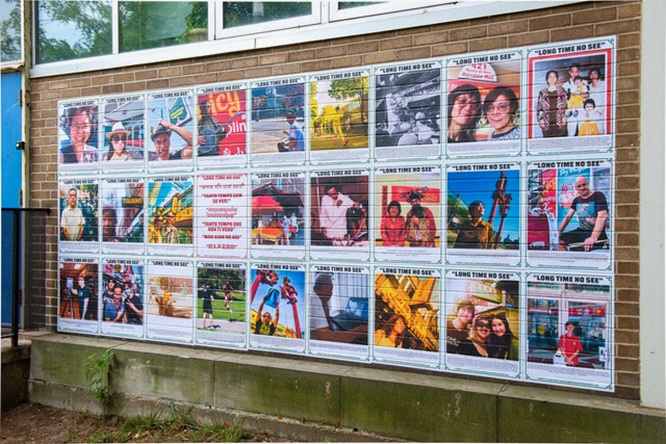
:: Our streets into a living room gallery (photo: © brenda joy lem)
When Audrey Jiang, one of the organizers of the Keith Lock retrospective,Intimate Diasporas, approached me to write something about Keith, she shared these words with me:
Camille Billops told bell hooks that the most revolutionary thing an artist can do is make work about their own life: "Put all your friends in it, everybody you loved, so one day they will find you and that you were all here together."
I thought of how long it can take for those of us who have been colonized or assimilated, to be “all here together”, and the different routes we take to scrape off the pressures and layers of assimilation, in order to, first, be wholly present to ourselves, and then, to find one another, to build and be in, community.
Long before I ever met Keith, my mother knew Keith’s mother, Joan. Chinatown was a small village then, Keith’s dad’s drugstore, a mainstay on Dundas St. My mother remembered Joan as “thew muhn.” I don’t know if there is an English equivalent of “thew muhn”, but my mom elaborated with ‘gentle, soft spoken’. Like Keith, my grandparents came to “Gum Sun” [1] around the time of the anti-Chinese expulsions (late 1880’s) a time when Chinese were chased out of town, their communities burned to the ground; anti-Chinese racism was rampant and condoned, upheld by both, the population and the governing rules of the population. These sentiments continued and became even more fully expressed with the Chinese Head Tax and then, the full denial of entry, with the Chinese Exclusion Act from 1923-1947. My mother, and Keith’s mother, Joan, were among the few who managed to enter the country during this time, my mother because she was born in Canada, and Joan, after receiving an Order in Council as a war bride. Life was often harsh. To be in the presence of kindness, was something my mother valued. Keith carries this quality in his work and in his being. Like his mother, I have never known Keith to be aggressive or pushy regarding his ideas or opinions. His beautiful life partner of 50+ years, Leslie, told me when she first saw his film, Work Bike and Eat, she felt “the person who made this film was a good person and I really wanted to meet him”. And once she met him, “I wanted to know him better.”
Keith and I met in the late 80’s when he generously offered support and advice as I embarked on making a first film with an Explorations grant. Later in the 90’s when he came to look at a rough cut of my second film, Keith met my life partner, Rick, and we made the discovery that both Rick’s and Keith’s fathers had belonged to Operation Oblivion, a Chinese Canadian undercover operation in the Second World War. Both their mothers entered Canada as war brides, having met the men while they had been stationed in Australia. We kept in touch over these 30+ years having dinner at each other’s homes. But it is only in these last few years working together on Chinatown community art projects as members of our group LTNS (Long Time No See) [2] that we have managed to put our friends and families all together in our work. It feels incredibly poignant to have large scale posters with photos of not only our friends and families, but also our ancestors, Keith in front of his father’s drugstore in old Chinatown, Rick holding his grandfather’s C.I. 44 certificate, my father pouring tea at the old Sai Woo restaurant, my mother in her church clothes, all here together, wheatpasted on multiple walls of Chinatown, turning our streets into a living room gallery.
[1] Golden Mountain in Cantonese.
[2] LTNS is a non-profit ad hoc group of friends, who are artists and educators in Toronto’s Chinatown: www.instagram.com/ltnschinatown/.
*
brenda joy lem lives in Tkaronto where she cooks, gardens, writes, plays taiko, improvises on voice and piano, makes collages, films & silkscreen prints and takes care of her family and community.
 |
envoyer par courriel | 
| imprimer | Tweet |





Site créé sur mesure pour Panorama-Cinéma par  .
.